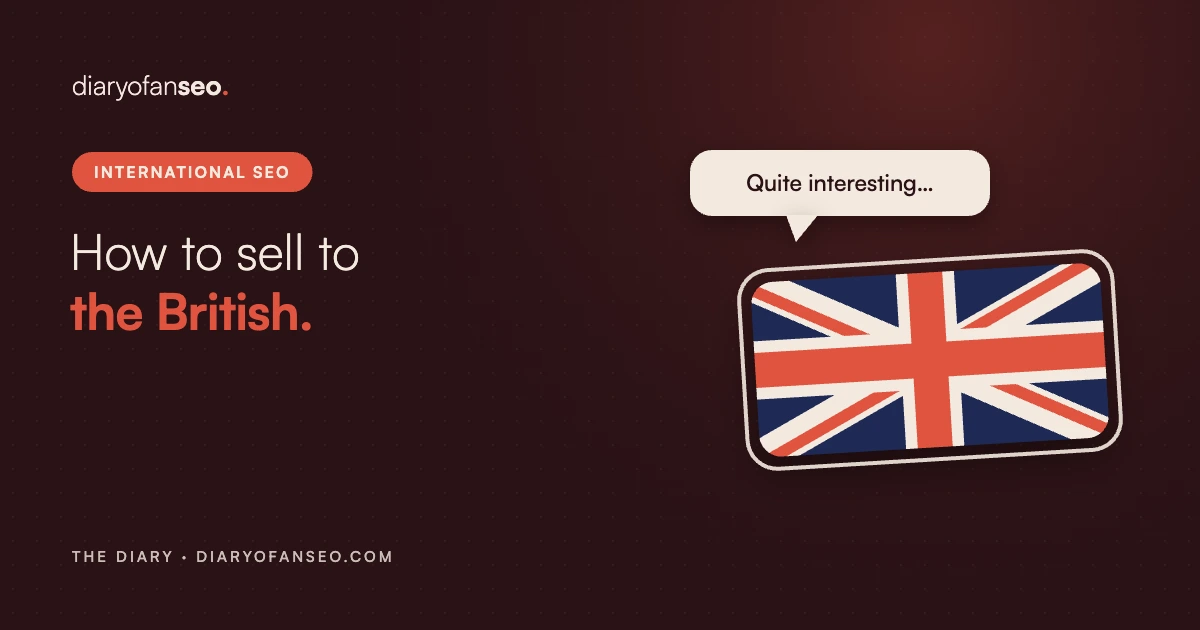
The British will rarely tell you that your pitch was bad. They will say it was “interesting”, offer you another biscuit and never reply to your follow-up email (I am allowed to say this; my husband is British). If you are expanding into the UK, learning to read that politeness is worth more than any discount code.
This guide to UK business culture pulls together what the research actually says about how British buyers like to be spoken to, how they decide, and what puts them off. Where the evidence is solid, we cite it. Where it is closer to widely observed habit, we say so. And a caveat up front: 69 million people do not share one personality. Don’t treat everything below as a rulebook, obviously!
What the research says about UK business culture
Three bodies of research come up again and again when people compare national business cultures.
Hofstede’s cultural dimensions. The Culture Factor (formerly Hofstede Insights) currently scores the UK at 35 for Power Distance, 76 for Individualism, 66 for Motivation towards Achievement and Success, 35 for Uncertainty Avoidance, 60 for Long Term Orientation and 69 for Indulgence (The Culture Factor, country comparison tool). Older published versions of the dataset gave the UK 89 for Individualism (TUM School of Management, Hofstede scores dataset), so you may see different figures quoted elsewhere. The headline is the same either way: low hierarchy, high individualism, comfortable with ambiguity.
The Culture Factor’s own description of the UK is useful for anyone selling there. It points to an “apparent contradiction between the British culture of modesty and understatement and the underlying, success-driven value system”, adding that “what is said is not always what is meant, so reading between the lines is essential” (The Culture Factor).
The GLOBE study. GLOBE groups England with the US, Canada, Australia, Ireland, New Zealand and (white) South Africa in an “Anglo cluster” characterised by an individualistic performance orientation and a preference for leaders who combine charisma with a participative style (Ashkanasy, Trevor-Roberts and Earnshaw, 2002; GLOBE Project, Anglo results). In other words, the UK and US share a lot. The differences are in the delivery.
Erin Meyer’s Culture Map. INSEAD professor Erin Meyer places cultures on eight scales, building on anthropologist Edward T. Hall’s idea of high and low context communication (Meyer, Harvard Business Review, 2014; Hall, Beyond Culture, 1976). Two findings matter most here. First, she notes that American and British managers tend to be persuaded by “applications first” (inductive) reasoning, while Germanic and southern European cultures prefer “principles first” (deductive) arguments. Second, she groups Britain with the US and Germany as “task based” cultures, where trust is built through doing good work together rather than through a long personal courtship (Erin Meyer, Culture Map scales).
How the British prefer to be spoken to
Understatement and polite codes
This is where most overseas sellers trip up, and it is one of the few areas with hard numbers behind it. A YouGov survey of Britons and Americans found that 68% of Britons understand “with the greatest respect” to mean “I think you are an idiot”, while 49% of Americans take it at face value as “I am listening to you”. The majority of Britons (55%) said “I’ll bear it in mind” means “I’ve forgotten it already”, against only 38% of Americans (YouGov, 2019).
For sellers, the practical lesson is simple. Soft language from a British buyer is often a real answer. “That’s quite interesting, let me have a think” may well be a no. Ask clear, low-pressure questions (“Would it help if I sent a short comparison, or is the timing not right?”) so they can say no politely, which they would much rather do than ghost you.
Humour and not taking yourself too seriously
Research on British and Australian banter found that teasing and mock insults are often read as friendly rather than rude, rooted in a shared value of “not taking yourself too seriously” (Haugh and Bousfield, Journal of Pragmatics, 2012). One of the recurring targets of that mockery was people “lacking an appropriate degree of modesty”. Note the study looked at male friendship groups in the North West of England, so do not stretch it too far. Still, it supports what most people who work in the UK observe: a little self-deprecation goes down well, and boasting does not.
That does not mean you should open a sales call with jokes. Let humour arrive naturally, keep it light and aim it at yourself, never at the buyer or their company.
Hype tolerance
Low. The combination of a modesty norm and high scepticism means superlatives (“revolutionary”, “best in class”, “game-changing”) tend to land badly. This is a widely observed pattern rather than something we can put a precise figure on, but it fits the Hofstede description above and the trust data below. Swap adjectives for evidence: numbers, named clients, case studies, independent reviews.
Formality and small talk
With a Power Distance score of 35, the UK is relatively egalitarian (The Culture Factor). First names are normal quickly in most business settings, though more traditional sectors (law, finance, public sector) can start more formally. A few minutes of small talk, the weather and the journey are classics, is the usual warm-up. Keep it brief and neutral, and avoid prying personal questions early on.
How to approach British buyers
First contact and cold outreach
Keep first messages short, specific and modest. Lead with why you are contacting this person, one relevant proof point and an easy next step. Also check the law. Under the UK’s PECR rules you can send unsolicited marketing emails to corporate subscribers (such as limited companies) without prior consent, provided you identify yourself and offer a working opt-out, but sole traders and some partnerships count as individuals and need consent or a valid soft opt-in (ICO, business-to-business marketing).
Sales calls and meetings
Because Meyer finds British managers lean towards applications-first reasoning (Erin Meyer), open with the practical outcome and a real example, then explain the method if asked. Do not spend ten slides on theory before you get to the point.
The UK also scores low on Uncertainty Avoidance (35), which The Culture Factor associates with comfort in “muddling through” and flexible plans (The Culture Factor). In practice this can mean buyers are open to trying something new, but they will want a sensible pilot rather than a three-year lock-in.
Trust signals
Trust is the big one, especially for overseas brands. The 2026 Edelman Trust Barometer found that people in the UK trust domestic companies 25 points more than foreign ones, a wider gap than in the US (16 points). UK respondents also trusted scientists (74%) and neighbours (69%) far more than CEOs (37%) (Edelman, 2026 Trust Barometer: Top 10 UK findings).
Read that as a to-do list. Show a UK address or UK team if you have one, UK client logos, UK case studies, recognised accreditations and experts rather than executives as your spokespeople.
Reviews
Reviews matter in the UK as much as anywhere. The UK government reports that reviews are used by 90% of consumers (GOV.UK, 2025). Since 6 April 2025, the Digital Markets, Competition and Consumers Act has banned fake reviews and concealed incentivised reviews, and businesses that publish reviews must take reasonable steps to prevent and remove fakes (CMA, fake reviews guidance). Collect real reviews steadily, reply to them like a human, and never buy them.
Pricing and negotiation
Two legal points first. Prices shown to consumers in UK advertising must include VAT (ASA, compulsory costs and charges: VAT). And since April 2025 all unavoidable fees must be included in the headline price, so no dripping in a booking fee at checkout (GOV.UK, 2025).
On negotiation style, we found little rigorous UK-specific research, so treat this as common observation: British buyers tend to prefer fair, transparent pricing and a reasonable opening position over aggressive anchoring followed by big discounts. A huge discount can make your original price look unserious.
Decision making and follow-up
B2B buying everywhere has become a group sport done largely without salespeople. Gartner’s survey of 750 B2B buyers found they spend only 17% of their buying time meeting potential suppliers (Gartner). That is a global figure, not a UK one, but it means your website and content are doing most of the selling.
Follow up, but gently. One polite nudge after a week, then a useful resource, then a clear “shall I close the file?” email usually works better than daily chasers. Persistence is fine; pressure is not.
What this means for your website and marketing copy
- Tone: plain, warm and quietly confident. Let proof do the boasting.
- Spelling: use British spelling and vocabulary (colour, organise, optimise, post code, mobile). US spelling on a UK site signals that you have not really arrived.
- Claims: UK advertising claims must be capable of substantiation under the CAP Code, so “the UK’s number one” needs evidence behind it (ASA, CAP Code rule 3.7).
- Social proof: UK reviews, UK case studies and recognisable UK brands carry more weight than global logo walls, given the domestic trust gap in the Edelman data above.
- Localisation: prices in pounds with VAT included for consumers, UK phone numbers, UK date formats (30/10/2026) and local delivery and returns information.
UK vs US vs Germany at a glance
| United Kingdom | United States | Germany | |
|---|---|---|---|
| Power Distance (Culture Factor) | 35 | 40 | 35 |
| Individualism (Culture Factor) | 76 | 60 | 79 |
| Uncertainty Avoidance (Culture Factor) | 35 | 46 | 65 |
| Persuasion style (Meyer) | Applications first | Applications first | Principles first |
| Communication | Low context but heavy on understatement and polite codes (YouGov) | Low context, explicit (Meyer) | Low context, very direct (Meyer; Culture Factor) |
| Hype tolerance | Low (widely observed) | Higher (see Tsai et al., 2006, below) | Low; expects expertise and detail (Culture Factor) |
| Domestic trust advantage (Edelman 2026) | 25 points | 16 points | 29 points |
Sources: The Culture Factor; Erin Meyer; YouGov; Edelman.
Compared with the US: both are task-based, applications-first cultures, but research on “ideal affect” found European Americans value high-energy positive feelings such as excitement more than some other groups (Tsai, Knutson and Fung, 2006). That study compared Americans with Hong Kong Chinese, not Britons, so we cannot say it proves a UK and US gap. But it helps explain why enthusiastic American copy can read as overselling to a British ear.
Compared with Germany: The Culture Factor describes German communication as “among the most direct in the world” and notes a reliance on expertise and a preference for deductive thinking (The Culture Factor). A German buyer may want the full technical case up front; a British buyer usually wants the outcome first and the detail on request. Germany’s higher Uncertainty Avoidance (65 against the UK’s 35) also suggests German buyers expect more thorough documentation before committing.
Not all Britons are the same
The UK is four nations and many regions. A study of nearly 390,000 people across Great Britain found clear regional personality differences: for example, agreeableness was higher in Scotland and extraversion higher in London and parts of southern England (Rentfrow, Jokela and Lamb, PLOS ONE, 2015). Practically, that means calling a Scottish buyer “English” is a mistake you only make once, a London fintech and a family-run Yorkshire manufacturer will expect different tones, and age, sector and individual personality matter at least as much as nationality.
Common mistakes when selling to the British
- Taking polite answers literally. “Interesting” and “I’ll bear it in mind” are often soft noes (YouGov).
- Overselling. Superlatives without proof undercut you in a modesty-valuing culture.
- Ignoring the foreign-brand trust gap. Without UK proof points you start 25 points behind (Edelman).
- Showing ex-VAT prices to consumers or adding fees at checkout.
- Using US spelling and US examples on a “UK” page.
- Chasing too hard. Daily follow-ups feel like pressure.
- Treating the UK as England. Scotland, Wales and Northern Ireland notice.
Practical checklist
- UK-specific landing pages in British English
- Prices in GBP, VAT-inclusive for consumers, no hidden mandatory fees
- UK reviews collected steadily and answered, with no incentivised or fake reviews
- UK case studies, client logos and accreditations visible
- Every marketing claim backed by evidence you could show the ASA
- Cold email process checked against ICO guidance for corporate versus individual subscribers
- Sales deck that leads with outcomes and examples, detail on request
- Follow-up sequence that is spaced out and easy to say no to
- Copy reviewed by a native British English speaker for tone, not just spelling
FAQs
Are British people indirect?
Partly. The UK is broadly a low-context, explicit culture compared with, say, Japan (Erin Meyer), but polite codes and understatement mean negative messages are often softened (YouGov). Expect directness on facts and gentleness on bad news.
Should I use humour when selling in the UK?
Light, self-deprecating humour is often welcome, in line with research on the British value of “not taking yourself too seriously” (Haugh and Bousfield, 2012). Forced jokes, or humour at the buyer’s expense, are not.
Do I need British spelling if I am already selling in the US?
If you want to rank and convert in the UK, yes. Separate UK pages in British English, with UK prices and proof, tell buyers and search engines that the page is meant for them.
How important are online reviews in the UK?
Very. The UK government says reviews are used by 90% of consumers, and fake reviews are now banned under the DMCC Act (GOV.UK).
Is the UK similar to the US for B2B sales?
In structure, yes: both are individualistic, performance-oriented and task based (GLOBE; Erin Meyer). In tone, no. What sounds confident in Chicago can sound like bluster in Birmingham. For the American side, read our guide on how to sell to Americans.
The honest bit: where we come in
Culture only helps you if British buyers can find you in the first place. At Diary Of An SEO we help businesses build UK-ready websites that rank in UK search and sound like they belong there, from British English localisation to UK-specific content and trust signals. If the UK is your one big next market, our single-market SEO service is built for exactly that. If it is one of several, have a look at our Global Growth Partnership.
We will not promise you the moon. We will tell you, quite politely, what it will take. Get in touch and let’s have a chat.
References
- The Culture Factor Group. “Country Comparison Tool” (Germany, United Kingdom, United States). The Culture Factor, accessed 30 October 2026. https://www.theculturefactor.com/country-comparison-tool?countries=germany%2Cunited+kingdom%2Cunited+states
- TUM School of Management. “Hofstede cultural scores” (dataset). Technical University of Munich, n.d. https://www.mgt.tum.de/fileadmin/user_upload/Hofstede_cultural_scores.csv
- Ashkanasy, N. M., Trevor-Roberts, E. and Earnshaw, L. “The Anglo Cluster: legacy of the British empire.” Journal of World Business, 37(1), 28 to 39, 2002. https://doi.org/10.1016/s1090-9516(01)00072-4
- GLOBE Project. “Anglo Cluster Results.” GLOBE Project, n.d. https://globeproject.com/results/clusters/anglo%3Fmenu=list.html
- Meyer, E. “Navigating the Cultural Minefield.” Harvard Business Review, May 2014. https://hbr.org/2014/05/navigating-the-cultural-minefield
- Meyer, E. “Team Culture Mapping Report: the eight scales.” ErinMeyer.com, n.d. https://erinmeyer.com/team-culture-mapping-report/
- Hall, E. T. Beyond Culture. Anchor Press/Doubleday, 1976. https://openlibrary.org/books/OL21335737M/Beyond_culture.
- YouGov. “British subtext: Half of Americans wouldn’t be able to tell that a Briton is calling them an idiot.” YouGov, 2019. https://yougov.com/en-gb/articles/22271-half-americans-wouldnt-be-able-tell-british-person
- Haugh, M. and Bousfield, D. “Mock impoliteness, jocular mockery and jocular abuse in Australian and British English.” Journal of Pragmatics, 44(9), 1099 to 1114, 2012. https://doi.org/10.1016/j.pragma.2012.02.003
- Edelman. “2026 Edelman Trust Barometer: Top 10 UK Findings, Trust Amid Insularity.” Edelman, 2026. https://www.edelman.com/sites/g/files/aatuss191/files/uk/2026-01/Trust%20Barometer%202026_Top10_UK.pdf
- Information Commissioner’s Office. “Business-to-business marketing.” ICO, n.d. https://ico.org.uk/for-organisations/direct-marketing-and-privacy-and-electronic-communications/business-to-business-marketing/
- Department for Business and Trade. “Fake reviews and sneaky hidden fees banned once and for all.” GOV.UK, 2025. https://www.gov.uk/government/news/fake-reviews-and-sneaky-hidden-fees-banned-once-and-for-all
- Competition and Markets Authority. “Fake reviews (CMA208) guidance.” GOV.UK, 2025. https://www.gov.uk/government/publications/fake-reviews
- Advertising Standards Authority. “Compulsory costs and charges: VAT.” ASA and CAP, n.d. https://www.asa.org.uk/advice-online/compulsory-costs-and-charges-vat.html
- Committees of Advertising Practice. “UK Code of Non-broadcast Advertising (CAP Code), Section 3: Misleading advertising.” ASA and CAP, n.d. https://www.asa.org.uk/type/non_broadcast/code_section/03.html
- Gartner. “B2B Sales: Win more deals” (citing the Gartner 2017 Digital B2B Buyer Survey, n = 750). Gartner, n.d. https://emt.gartnerweb.com/ngw/globalassets/en/sales-service/documents/trends/win-more-b2b-sales-deals.pdf
- Tsai, J. L., Knutson, B. and Fung, H. H. “Cultural variation in affect valuation.” Journal of Personality and Social Psychology, 90(2), 288 to 307, 2006. https://doi.org/10.1037/0022-3514.90.2.288
- Rentfrow, P. J., Jokela, M. and Lamb, M. E. “Regional Personality Differences in Great Britain.” PLOS ONE, 10(3), e0122245, 2015. https://doi.org/10.1371/journal.pone.0122245