South Korea is one of the few markets where Google does not win search outright. It is also a country where the law now tells you what the first price on the screen must include, where marketing messages must be labelled as adverts, and where a buyer can judge your business by how carefully your page is put together before reading a word of your offer.
This guide is for service and product businesses based in the UK, US, Europe or elsewhere in Asia who want South Korean buyers to find their website, trust it, and book a call or place an order. It is not about bowing or business cards. It is about the words, prices, proof and buttons on your pages.
If you have read our guides on selling to the British and selling to Americans, you will see some sharp contrasts here, especially around risk and certainty.
Korean business culture, in plain English
Researchers often use Geert Hofstede’s six cultural dimensions to compare countries. Each country gets a score from 0 to 100 on each dimension. The scores are not a personality test for every individual. Think of them as the average “weather” of a market: useful for planning, never a guarantee for any one buyer.
| Dimension | South Korea | UK | US | What it means for your website |
|---|---|---|---|---|
| Power distance | 60 | 35 | 40 | Titles, credentials and who stands behind the business matter more |
| Individualism | 58 | 76 | 60 | Group belonging and relationships carry weight |
| Motivation towards achievement | 39 | 66 | 62 | Loud “number one” claims land less well |
| Uncertainty avoidance | 85 | 35 | 46 | Detail, process and guarantees reduce friction |
| Long-term orientation | 86 | 60 | 50 | Buyers look for staying power, not a quick win |
| Indulgence | 29 | 69 | 68 | A restrained, sensible tone suits most offers |
Source: The Culture Factor country comparison tool.
Uncertainty avoidance is the big one
The Culture Factor describes South Korea as one of the most uncertainty-avoiding countries in the world. In practice, a buyer who scores high here wants to know what happens next, how long it takes, what it costs and what happens if it goes wrong, before committing.
A real example: South Korean law now forces this kind of clarity into checkout pages. Since 14 February 2025, the amended E-Commerce Act has banned “drip pricing”, where extra fees appear only at the end. The government gave sellers a grace period that ended on 13 August 2025. The total, including taxes, fees and delivery, has to be shown on the first screen where the price appears. A culture that dislikes surprises has written that dislike into law.
For your website: add a short “How it works” section with numbered steps and realistic timings. State what the buyer receives, in what format, and by when. Put cancellation and refund terms in plain view, not behind a link in the footer.
Respect for hierarchy shows up as respect for credentials
The Culture Factor notes the elaborate system of honorifics in the Korean language, where how you speak changes with the age and status of the person you address. That is a concrete, daily expression of a power distance score of 60.
For your website: show who leads the business and their qualifications, with a real photo. Name your formal memberships, certifications and the size or type of organisations you work with. A faceless “we” page feels thin.
Long-term thinking means buyers check whether you will still be there
With a long-term orientation score of 86, South Korea sits far above the UK and the US. Buyers tend to reward persistence and stability over a flashy launch.
For your website: show your founding year, how long you have served clients, and how you support customers after the sale. A support or maintenance plan says “we are staying”.
Restraint over hype
South Korea scores 29 on indulgence and 39 on motivation towards achievement. The Culture Factor describes Korean society as valuing modesty and consensus and a sense of “jeong”, the warm bond built through shared experience. Self-promotion that reads as boasting can work against you.
A real example: the honorific system again. Language that shows respect for the listener is built into everyday speech, so marketing copy that shouts or talks down feels out of place.
For your website: swap “We are the best agency in Asia” for a specific, checkable result in the format “We helped [type of client] achieve [measurable result] in [time period]”, and only use it if you can show it.
How people search and buy in South Korea
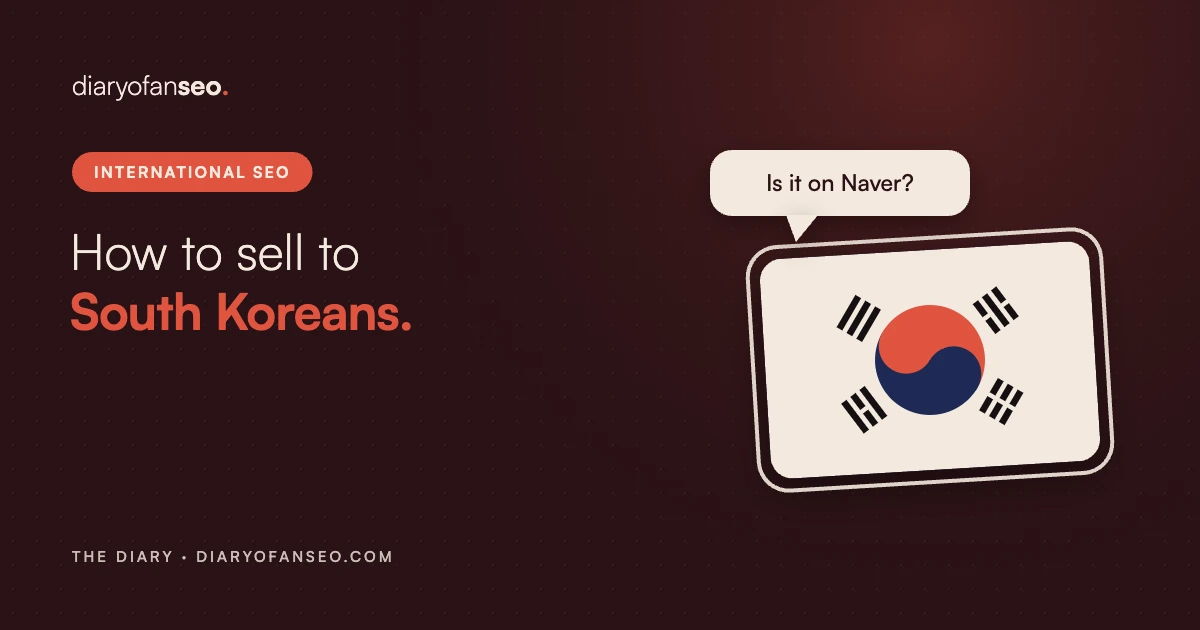
Search engines: Google and Naver are nearly level
StatCounter’s September 2026 figures for South Korea put Google at 47.97% and Naver at 43.05% of search engine usage, with Bing on 4.84% and Daum on 0.73%. StatCounter measures traffic from sites that carry its tracking code, so treat these as an indicator rather than a census. Even so, the picture is clear: if you only optimise for Google, you are ignoring a huge share of searches.
Naver SEO and Naver advertising
Naver is not just a search box. Its results draw heavily on Naver’s own Blog, Cafe, Place and Shopping services, as Coaley Peak’s guide to Naver’s AI answers explains. Naver Corp. says its AI Briefing, powered by its own HyperCLOVA X language model, became available to all search users in 2025, giving summaries with cited sources at the top of results. Naver later closed its CLOVA X chatbot and its Cue: AI search service in April 2026 and moved to an “AI Tab” conversational search experience.
What that means for your website:
- Register your site with Naver’s webmaster tools (Naver Search Advisor) and submit a sitemap.
- Publish Korean-language content that answers specific questions clearly, because AI summaries quote clear, well-sourced answers.
- Consider a presence on Naver’s own platforms, such as a Naver Blog, if you want to show up where Naver users look first.
- Naver advertising (search ads and shopping ads) is a fast way to test demand before investing in content. Send that paid traffic to a Korean landing page, not your English homepage.
AI assistants
ChatGPT is officially available in South Korea, according to OpenAI’s supported countries list. Kakao and OpenAI launched “ChatGPT for Kakao” on 28 October 2025, putting ChatGPT inside KakaoTalk chats, and Kakao has said it plans to launch its own AI, Kanana, inside the messenger. Naver’s HyperCLOVA X powers its AI search features.
What that means for your website: a buyer may first meet your business inside an AI answer. Clear facts on your site (what you do, who for, prices or price ranges, locations served) make it easier for AI systems to describe you correctly.
The channels that matter for selling
- KakaoTalk: Kakao’s Q2 2026 investor materials put KakaoTalk’s domestic monthly active users at close to 50 million. Many businesses use a KakaoTalk channel as a contact option.
- Coupang: Coupang reported 24.7 million product commerce active customers in Q2 2026. If you sell physical products, marketplaces may be where buyers compare you.
- YouTube and Instagram: DataReportal’s Digital 2026 South Korea report puts YouTube’s ad reach at 42.9 million users and Instagram’s at 25.6 million in late 2025. South Korea had 50.6 million internet users, 97.9% of the population.
For your website: offer a KakaoTalk contact button alongside email and a booking form. Some buyers will never fill in a long form but will happily send a chat message.
Korean marketing copy that earns a call
- Be specific, not superlative. Replace “world-class” with what you actually do, for whom and with what result.
- Answer the risk questions before they are asked. Timelines, what is included, what happens if it does not work.
- Write for skimmers who also read the detail. Clear headings, then complete detail underneath. High uncertainty avoidance means people do read the small print.
- Use a professional, polite register. If you translate, use a native translator who understands formal business Korean. Machine translation will often pick the wrong level of politeness.
- Low-pressure CTAs. “Book a 20-minute call to see if we are a fit” with a line underneath such as “No obligation. If we are not the right fit, we will tell you.” This gives the buyer an easy way out, which lowers the risk of saying yes.
Honest pricing beats a hard sell
In our experience, a buyer who is comparing five providers on price often chooses the one who explained the price most clearly, even if it was not the cheapest. Showing a starting price, what drives the cost up, and what is never included builds the certainty this market rewards.
Proof and trust signals South Korean buyers look for
- A named team with photos and credentials
- Your company registration details and a physical address
- Case studies with specifics (industry, problem, timeline, result)
- Client logos only where you have permission
- A clear refund or cancellation policy
- Korean-language customer support hours, stated in Korea Standard Time
No South Korean clients yet? Start with what you can prove
Every business that now has a client list in Seoul once had none. Lack of local proof is a starting point, not a reason to stay out. What you can do now:
- Show results from comparable markets, such as Japan or Singapore, and say plainly that they are from there.
- Offer a small, clearly scoped first project so the buyer’s risk is low.
- Publish detailed process pages. In a high uncertainty avoidance culture, a transparent process can partly stand in for testimonials you do not have yet.
- Add your first Korean review as soon as you have it, and date it.
Korea VAT, price display and the rules for foreign sellers
VAT: South Korea’s standard VAT rate is 10% (PwC Worldwide Tax Summaries).
Foreign digital service providers: under the VAT Act, foreign businesses that supply electronic services to consumers in South Korea must complete a simplified business registration within 20 days of starting. B2B supplies are excluded. A penalty for failing to register applies.
Price display: the E-Commerce Act changes described above mean that the first price shown must be the total, including taxes, mandatory fees and delivery. From 24 October 2025, guidance from the Korea Fair Trade Commission also covers hidden subscription renewals, so be clear about renewal dates and amounts.
Personal data (PIPA): South Korea’s Personal Information Protection Act requires consent for marketing to be obtained separately from other consent, and you cannot refuse service to someone who declines marketing consent (Article 22). Foreign businesses that meet certain thresholds must appoint a domestic agent (Article 31-2).
Advertising messages: under the Network Act, you need explicit prior opt-in to send advertising messages. Guidance based on KISA’s rules says messages should start with “(광고)”, meaning “advertisement”, must not be sent between 9pm and 8am without separate consent, must include a free way to opt out, and consent must be reconfirmed every two years. There is a limited exception for similar goods within six months of a completed transaction.
This is not legal advice. Check your situation with a qualified adviser.
For service businesses
- Show a price range or “from” price in Korean won, and say whether VAT is included.
- Explain your stages of work and what you need from the client at each step.
- Make the booking page show available times in Korea Standard Time.
- On your enquiry form, keep marketing consent as a separate, unticked checkbox.
For product businesses
- Show the full price, including delivery and any mandatory fees, on the first screen.
- State delivery times by region (see below).
- If you ship from abroad, explain customs. Korea Customs Service says imports for personal use are duty-free up to US$150, or US$200 for goods shipped from the US.
- Show returns and exchange terms in plain Korean.
Delivery to Jeju and the islands
Delivery across mainland South Korea is fast, but islands cost more. Hanjin Transportation publishes extra charges: 3,000 won airfare for Jeju, a 5,000 won ferry fee per box for island areas, and 8,000 won in total for minor islands within Jeju, such as Udo and Chuja-do.
For your website: if you add island surcharges, show them before checkout, in line with the all-in pricing rules. A simple note such as “Jeju and island deliveries: extra charge shown in your basket before you pay” prevents abandoned baskets and complaints.
Landing page before and after
| Element | Generic UK or US version | South Korea rewrite (illustrative) | Why |
|---|---|---|---|
| Headline | “The best SEO agency for ambitious brands” | “International SEO for brands entering South Korea, covering Google and Naver” | Specific beats superlative |
| Proof | “Trusted by hundreds of clients” | “[X] years in international SEO. Case studies from Japan and Singapore below” | Verifiable and honest about where proof comes from |
| Price | “Contact us for pricing” | “Projects from ₩X, VAT included. What changes the price is listed below” | Removes uncertainty |
| CTA | “Book your free strategy session now!” | “Book a 20-minute introductory call. No obligation” | Lower pressure, easy exit |
| Contact | Email form only | Form plus KakaoTalk button | Matches how people message |
Korean CTA example: 무료 상담 예약 (“book a free consultation”).
Korea compared with the UK and US
| Topic | South Korea | UK | US |
|---|---|---|---|
| Main search engines | Google and Naver | ||
| Tone | Polite, modest, detailed | Understated | Confident |
| Price display | Total on first screen by law | VAT-inclusive for consumers | Usually pre-tax |
FAQs
Do I need a Korean-language website? For consumers, almost certainly yes. For B2B, an English site may get you some enquiries, but a Korean landing page will usually convert better and is needed for Naver.
Is Naver SEO different from Google SEO? Yes. Naver gives a lot of space to its own services, such as Blog and Place, and now shows AI Briefing summaries. A good website still matters, but you may need a presence on Naver’s platforms too.
Do I need to register for Korea VAT? If you sell electronic services to consumers in South Korea, the simplified registration likely applies. Get advice for your case.
Can I email people who gave me their business card? Do not assume so. Korean rules require prior opt-in for advertising messages, with limited exceptions.
A market that rewards the careful
South Korea is not a market for the business that wants to be first with the loudest offer. It is a market for the business that is clearest. Total price on the first screen. A process a buyer can picture. Proof that is honest about where it came from. A call that is easy to book and easy to decline.
If you would like a second pair of eyes on how your pages read to a South Korean buyer, across Google and Naver, you can send us a note and we will tell you honestly whether we can help.
References
- The Culture Factor. “Country Comparison Tool: South Korea, United Kingdom, United States.” The Culture Factor Group. https://www.theculturefactor.com/country-comparison-tool?countries=south+korea
- StatCounter. “Search Engine Market Share South Korea, September 2026.” StatCounter Global Stats, 2026. https://gs.statcounter.com/search-engine-market-share/all/south-korea
- NAVER Corp. “Present an evolved AI Briefing of Naver Search.” NAVER, 2025. https://navercorp.com/en/story/storyDetail?seq=32526
- Maeil Business Newspaper. “Naver and Kakao Shift AI Strategy Under Big Tech Onslaught.” MK, 2026. https://www.mk.co.kr/en/business/11975332
- Kakao. “Kakao Releases ChatGPT for Kakao.” Kakao Corp., 2025. https://www.kakaocorp.com/page/detail/11794
- Kakao. “2Q 2026 Earnings Announcement.” Kakao Corp., 2026. https://t1.kakaocdn.net/kakaocorp/admin/ir/results-announcement/6067.pdf
- Coupang. “Coupang Announces Results for Second Quarter 2026.” Coupang, 2026. https://ir.aboutcoupang.com/news-events/news/news-details/2026/Coupang-Announces-Results-for-Second-Quarter-2026/default.aspx
- OpenAI. “ChatGPT Supported Countries.” OpenAI Help Center. https://help.openai.com/en/articles/7947663-chatgpt-supported-countries
- DataReportal. “Digital 2026: South Korea.” Kepios, 2026. https://datareportal.com/reports/digital-2026-south-korea
- Korea Policy Briefing. “Drip pricing ban under the amended E-Commerce Act.” Korea.kr, 2025. https://www.korea.kr/news/policyNewsView.do?newsId=148939436
- Yulchon LLC. “Amendments to the E-Commerce Act.” Yulchon, 2025. https://www.yulchon.com/en/resources/publications/newsletter-view/41347/page.do
- Newsis. “KFTC guidelines on hidden renewals.” Newsis, 2025. https://www.newsis.com/view/NISX20251023_0003373698
- Ministry of Government Legislation. “Personal Information Protection Act.” Korea Law Information Center. https://www.law.go.kr/LSW/eng/engLsInfoR.do?lsiSeq=283839
- NHN Cloud. “SMS service policy and preconditions (advertising message rules).” NHN Cloud Docs. https://docs.nhncloud.com/en/Notification/Notification%20Hub/en/service-policy-and-precondition/sms/
- PwC. “Republic of Korea: Corporate, Other taxes.” Worldwide Tax Summaries. https://taxsummaries.pwc.com/republic-of-korea/corporate/other-taxes
- Korea Customs Service. “Duty-free import of goods for personal use.” Korea Customs Service. https://www.customs.go.kr/kcs_english/cm/cntnts/cntntsView.do?cntntsId=2733&mi=8057
- Hanjin Transportation. “Delivery charges for Jeju and island areas.” Hanjin. https://hanjin.com/kor/CMS/Contents/Contents.do?mCode=MN130
- Coaley Peak. “Naver and HyperCLOVA X: How Korea’s own search engine writes AI answers.” Coaley Peak, 2026. https://www.coaleypeak.co.uk/geo/engines/naver