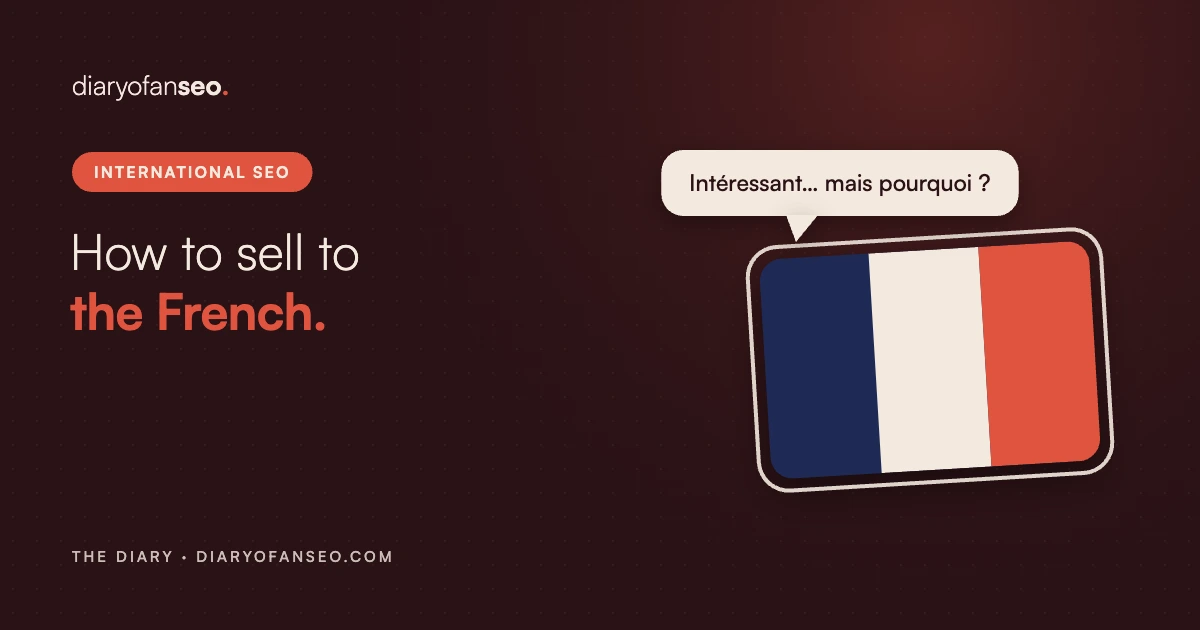
An American consultant once stood up in Paris to give a crisp, practical training session: tools, examples, next steps. Within minutes the questions started. How did you reach these conclusions? What was your methodology? The consultant was Erin Meyer, now an INSEAD professor (Meyer, “Tailor Your Presentation to Fit the Culture”). Your website faces the same audience, except it cannot hear the questions. It has to answer them on the page.
This guide covers selling to French buyers through your website: wording, structure, proof, pricing, and turning a visitor into a booked sales call. As in our guides to selling to the British and selling to Americans, we cite evidence where it exists and flag common practitioner observation as such. With 69.1 million inhabitants (INSEE, 2026) and 80% of people aged 16 to 74 buying online in the past year (Eurostat, 2025), France is a market where the website does a great deal of the early selling.
What the research says about French buyers
Hofstede’s cultural dimensions. The Culture Factor (formerly Hofstede Insights) scores France at 68 for Power Distance, 74 for Individualism, 43 for Motivation towards Achievement and Success, 86 for Uncertainty Avoidance, 60 for Long Term Orientation and 48 for Indulgence (The Culture Factor, country comparison tool). For copywriters, Uncertainty Avoidance matters most: The Culture Factor says “the French dislike surprises” and “like to receive all the necessary information” in advance.
The GLOBE study. GLOBE places France in a “Latin Europe” cluster that scores high on Power Distance (Jesuino, Journal of World Business, 2002), unlike the “Anglo cluster” of the UK and US. Expertise and correct forms of address carry real weight.
Erin Meyer’s Culture Map. In The Culture Map (Meyer, 2014), Meyer describes France as relatively high context but “much more direct when it comes to negative feedback” than Americans (Erin Meyer, Culture Map scales). Above all, France is “principles-first”: people “seek to understand the ‘why’ behind proposals or requests before they move to action” (Meyer). On a web page, that “why” is your method.
How to write website copy for French readers
Language first: French, and the Loi Toubon
This is partly a legal matter. The Loi Toubon (Law no. 94-665 of 4 August 1994) makes French compulsory in the designation, offer and presentation of goods and services, and in “toute publicité écrite, parlée ou audiovisuelle”, meaning all written, spoken or audiovisual advertising (Légifrance, Loi n° 94-665, article 2). Where you add other languages, the French version “doit être aussi lisible, audible ou intelligible” as the foreign one (Légifrance, article 4).
Brand names are exempt, but foreign-language slogans need a faithful French translation (DGCCRF, L’emploi de la langue française), and the ARPP, the advertising self-regulator, applies the rules to digital media too (ARPP, Fiche de doctrine langue française). Documents such as invoices exchanged between businesses that are not end users fall outside the obligation, so pure B2B sellers should take legal advice.
The commercial case is just as strong. Only 53% of people in France say they can hold a conversation in a language other than their mother tongue, against an EU average of 59% (European Commission, Special Eurobarometer 540, 2024). And a study of 715 young, highly educated consumers in five countries, France included, found that almost 40% of English phrases in adverts were not understood (Gerritsen et al., Journal of Global Marketing, 2010). Translate the buttons, the form labels and the image text too.
Vous or tu?
With a Power Distance score of 68 (The Culture Factor), “vous” is the safe default for B2B and most professional services. We found no rigorous research on “tu” in French web copy, so treat this as practitioner observation: some consumer and youth brands use “tu” deliberately, but if you choose it, choose it everywhere, from headlines to error messages and emails. Mixing the two looks careless.
Reasoning before results
A British or American landing page often opens with the outcome and a big number. For principles-first readers, Meyer recommends “explaining and validating the concept underlying your reasoning before coming to conclusions and examples” (Meyer). On a page, that means a short “notre méthode” section near the top, then the results, then the proof.
Directness and claims
French readers can take frank, critical statements, but in our experience they are rarely moved by “revolutionary” or “the best” on their own. Swap adjectives for method, evidence and credentials. A precise claim with a source reads as confident. A vague superlative reads as marketing.
Proof and trust signals French buyers look for
Mentions légales and legal pages
Every professional website in France must show its “mentions légales”: company name, legal form and share capital, registered address, email and phone, registration number, VAT number where applicable and the host’s details. Failing to do so can be fined up to €375,000 for a company (Service Public Entreprendre, mentions obligatoires). A complete page also tells a cautious visitor that a real, accountable business stands behind the site.
Reviews
France regulates online reviews closely. Businesses that publish reviews must show, among other things, the date of each review, how reviews are ranked, whether anything was given in exchange and how they are checked. Fake or altered reviews can bring up to two years in prison and a €300,000 fine (economie.gouv.fr, avis en ligne). Show reviews openly, with a short “how we check reviews” note.
Credentials, case studies and certifications
In a high Power Distance culture, named experts, qualifications, certifications and detailed case studies carry weight. Structure case studies as context, method, result.
Data protection and cookies
Your cookie banner is your real first impression. The CNIL says refusing trackers must be as easy as accepting them, and considers a “tout refuser” button at the same level and in the same style as “tout accepter” a clear way to achieve that (CNIL, cookies FAQ).
Pricing pages
Consumer prices must be shown in euros “toutes taxes comprises”, including VAT, with extra costs such as delivery disclosed before the buyer commits. If a distance seller fails to mention those extras, the consumer does not have to pay them (DGCCRF, L’information sur les prix). For B2B, state clearly whether prices are HT (excluding VAT) or TTC. Say what is included and how billing works. “Sur devis” (on quotation) is common for services, but in our experience a starting price or a worked example keeps more visitors reading.
Forms, contact and booking pages
Ask only for what you need. The GDPR requires personal data to be “adequate, relevant and limited to what is necessary” (GDPR, article 5(1)(c)), and every extra field is another reason to leave. In our experience, French contact and booking pages also work better with French labels and date formats (31/10/2026), a clear note on who will reply, in what language and how quickly, and any newsletter opt-in kept separate from the request.
CTAs and the path to a sales call
A principles-first reader wants to understand before committing, so a lone “Réserver une démo” (book a demo) button can feel premature. In our experience, two steps work better: a softer first CTA such as “Découvrir notre méthode” (discover our method), followed further down by a clear “Planifier un échange de 30 minutes” (schedule a 30 minute conversation). Tell people what the call will cover, in what language and that there is no commitment.
Follow-up emails and consent
Check the rules before you send anything. The CNIL says business-to-business email prospecting does not need prior consent when the message relates to the recipient’s professional role, the person has been informed and they can object simply and free of charge. Consumers generally need to have opted in (CNIL, prospection commerciale par courrier électronique). Every message must identify the sender, offer a simple unsubscribe link and point to your privacy policy (CNIL, B to B). Write follow-ups in French, with “vous” and one clear next step.
Running the sales call
Most first calls now happen on video. Send a short agenda beforehand, which suits a high Uncertainty Avoidance culture (The Culture Factor). Open with your reasoning, then the recommendation. Expect challenge: Meyer finds France among cultures “quite comfortable having spirited, confrontational meetings” (Erin Meyer), and advises leaving “enough time for challenge and debate of the underlying concepts” (Meyer). Hard questions often mean interest. In a hierarchical culture, ask early who else will be involved in the decision, and recap in writing, in French, afterwards. In person, the same rules hold.
No French clients yet? Starting from zero in France
“We have no French clients or reviews yet. Can we still sell there?” Yes. It is a stage, not a blocker, but it does limit you: you are asking a visitor in an Uncertainty Avoidance 86 culture to take a bigger leap. Your job is to shrink it.
- Translate the proof you have, and say where it is from. Case studies and testimonials from other markets still count. English promotional text needs a French version (DGCCRF), so translate faithfully, name the client’s country and never pass them off as French.
- Show method and expertise. For principles-first readers, a clear method, named experts and certifications do some of the work French case studies would.
- Look local where you genuinely are. A French phone number, a French-speaking contact, complete mentions légales and any French VAT number or address you have. Membership of a recognised professional body or your bilateral chamber of commerce in France helps.
- Strengthen the guarantee and spell it out. “Satisfait ou remboursé” with the conditions in plain view, or a short paid pilot with a clear exit.
- Recruit founding clients. Offer a limited “programme clients fondateurs”. Ask for reviews, and say if anything was given in exchange, as French rules require (economie.gouv.fr).
- Borrow credibility. French partners, trade press or events give you a local reference point quickly.
- Be upfront. In our experience, a page that says “nouveau en France” and explains why you came reads better than one implying a history you do not have.
Landing page copy: the French way to say it
The table adapts eight common landing page lines from punchy international English for French buyers, with an English gloss. Imagine a small bookkeeping app for small businesses.
Please note: every line in this section is an illustrative example written for this guide. None of it is quoted from a real company, and any French copy should be finalised by a native-speaking copywriter.
| Landing page element | Generic English version (illustrative) | French adaptation (illustrative) | Why it works in France |
|---|---|---|---|
| Hero headline | “The #1 bookkeeping app. Period.” | “Une comptabilité claire, pensée pour les petites entreprises” (Clear bookkeeping, designed for small businesses) | A principles-first reader wants substance and a reason, not a bare superlative (Meyer). |
| Body opener | “Stop wasting hours on admin!” | “Notre méthode : vos factures, dépenses et TVA réunies, vérifiées chaque mois par un expert-comptable.” (Our method: your invoices, expenses and VAT in one place, checked each month by a chartered accountant.) | The “why” and the method come before the promise (Meyer), and expertise is a strong signal in a high Power Distance culture (The Culture Factor). |
| Pricing line | “Competitive pricing!” | “À partir de [19] € TTC par mois. Sans frais cachés.” (From €[19] a month including VAT. No hidden fees.) | Consumer prices must include taxes, with extra costs disclosed up front (DGCCRF). |
| Primary CTA | “Book a demo now!” | “Planifier un échange de 30 minutes, en français et sans engagement” (Schedule a 30 minute conversation, in French, with no commitment) | Saying exactly what the call involves removes uncertainty for readers who dislike surprises (The Culture Factor). |
| Guarantee | “Love it or your money back!” | “Satisfait ou remboursé pendant 30 jours, conditions détaillées ici” (Satisfied or refunded for 30 days, full terms here) | High Uncertainty Avoidance means readers want the detail behind the promise (The Culture Factor). |
| Social proof | “Loved by 10,000+ users worldwide” | “Plus de [300] entreprises nous font confiance en Europe. Avis datés et vérifiés : voici comment.” (More than [300] businesses in Europe trust us. Dated, verified reviews: here is how.) | French rules require transparency on how reviews are collected and checked (economie.gouv.fr). |
| Booking form intro | “Fill in the form and we’ll be in touch!” | “Trois champs seulement. Un conseiller francophone vous répond sous 24 h ouvrées.” (Just three fields. A French-speaking adviser replies within one working day.) | Data minimisation is a legal principle (GDPR, article 5), and stating the next step reduces uncertainty (practitioner observation). |
| English slogan | “Smart money, made simple” (left in English) | “L’argent, simplement” with any English tagline translated alongside | Foreign-language slogans need a French translation that is at least as legible (Légifrance, article 4). |
Figures in square brackets are placeholders. Only publish numbers you can prove.
Sample hero opener (illustrative)
- Headline: Votre comptabilité, enfin claire (Your bookkeeping, clear at last)
- Subhead: Facturation, dépenses et TVA réunies dans un seul outil, conçu avec des experts-comptables pour les petites entreprises. (Invoicing, expenses and VAT in one tool, designed with chartered accountants for small businesses.)
- Primary CTA: Découvrir notre méthode (Discover our method)
- Secondary CTA: Planifier un échange de 30 minutes (Schedule a 30 minute conversation)
France vs UK vs US at a glance
| France | United Kingdom | United States | |
|---|---|---|---|
| Power Distance (Culture Factor) | 68 | 35 | 40 |
| Uncertainty Avoidance (Culture Factor) | 86 | 35 | 46 |
| Persuasion style (Meyer) | Principles first | Applications first | Applications first |
| Communication (Meyer) | Relatively high context | Low context, with understatement (YouGov) | Low context, explicit |
| Page structure that suits it | Method, then results, then proof | Practical outcome, modestly told | Outcome and numbers first |
| Language law for advertising | Loi Toubon: French compulsory | None covered in our sources | None covered in our sources |
Sources: The Culture Factor; Erin Meyer; YouGov; Légifrance. The “page structure” row is our practitioner reading of the research.
Compared with the UK and US: a British page can be light and understated, and a US page leads with results. A French page needs more structure, more formality and the reasoning first (Meyer), so a translated US landing page can look superficial in France.
Not all French speakers are the same
“French-speaking” does not mean “France”. The Culture Factor notes that Quebec’s profile (Power Distance 54, Uncertainty Avoidance 60) differs from France’s (The Culture Factor). Give each its own pages.
Common mistakes when selling to the French
- An English site, or English buttons and banners on a French one. It risks breaching the Loi Toubon, and many readers simply won’t understand it (Gerritsen et al., 2010).
- Results without the reasoning. Pages that skip the method look shallow.
- Mixing “tu” and “vous”, or using “tu” in a formal sector.
- Hiding VAT or extra costs from consumers.
- Missing mentions légales or a cookie banner that makes refusing hard.
- A hard “book a demo” as the only option.
Practical checklist
- Every page, button, form and email in natural French, using one register throughout
- A “notre méthode” section before the results
- Complete mentions légales and French-language privacy information
- Prices in euros, TTC for consumers, HT or TTC clearly labelled for B2B
- Reviews with dates and a note on how they are checked
- Short forms, French date formats and a clear “what happens next”
- A two-step CTA path to a clearly described call
- Follow-up emails checked against CNIL guidance
FAQs
Do I need a French version of my website to sell in France?
In practice, yes. The Loi Toubon makes French compulsory in the offer of goods and services and in advertising (Légifrance), and only 53% of people in France can hold a conversation in a second language (Eurobarometer 540).
Should my French website use “tu” or “vous”?
“Vous” is the safe default for B2B and most professional services, given France’s high Power Distance score (The Culture Factor). Some consumer brands choose “tu” deliberately. Whichever you pick, use it consistently.
Can I keep my English slogan in France?
Your brand name, yes. Foreign-language messages attached to a brand need a French translation that is at least as legible (DGCCRF).
Can I email French prospects who download a guide or fill in a form?
For business contacts, B2B email prospecting can be done without prior consent if it relates to the recipient’s job, they were informed and they can easily object. Consumers generally need to opt in (CNIL).
How is a French landing page different from a UK one?
More structure, more formality and the method first. Our guide to selling to the British covers the other side of the Channel.
Bien plus qu’une traduction: getting French search right
Plenty of businesses arrive in France with a translated website and wonder why the calendar stays empty. These are the French pitfalls we help clients avoid at Diary Of An SEO:
- Keywords nobody in France types. A translated keyword list misses how French buyers phrase their searches, so we research French terms from scratch.
- Loi Toubon blind spots. English slogans, button labels, image text and booking widgets that slipped through translation. We flag them before launch, so your lawyer can sign off.
- One “French” page for every French-speaking market. France, Belgium, Switzerland and Quebec need their own targeting. We set up hreflang (fr-FR, fr-BE, fr-CH, fr-CA) so the right page reaches the right country.
- Pages that sell the result but skip the reasoning. We help shape French pages that explain the method, so principles-first readers keep reading all the way to the booking form.
- Proof that only works in English. We help you present translated case studies, French reviews and a French contact route where they influence decisions.
If France is your next big market, our single-market SEO service focuses everything there. If you would like a frank, well-argued view of your French site, very much in the local style, talk to us.
References
- The Culture Factor Group. “Country Comparison Tool” (France, Germany, United Kingdom, United States). The Culture Factor, accessed 31 October 2026. https://www.theculturefactor.com/country-comparison-tool?countries=france%2Cgermany%2Cunited+kingdom%2Cunited+states
- Jesuino, J. C. “Latin Europe cluster: from South to North.” Journal of World Business, 37(1), 81 to 89, 2002. https://doi.org/10.1016/s1090-9516(01)00076-1
- Meyer, E. “Team Culture Mapping Report: the eight scales.” ErinMeyer.com, n.d. https://erinmeyer.com/team-culture-mapping-report/
- Meyer, E. “Tailor Your Presentation to Fit the Culture.” ErinMeyer.com (originally Harvard Business Review), n.d. https://erinmeyer.com/tailor-your-presentation-to-fit-the-culture/
- Meyer, E. The Culture Map: Breaking Through the Invisible Boundaries of Global Business. PublicAffairs, 2014. https://www.publicaffairsbooks.com/titles/erin-meyer/the-culture-map/9781610392761/
- République française. “Loi n° 94-665 du 4 août 1994 relative à l’emploi de la langue française” (Loi Toubon), articles 2 and 4. Légifrance. https://www.legifrance.gouv.fr/loda/id/LEGITEXT000005616341
- DGCCRF. “L’emploi de la langue française.” economie.gouv.fr, 12 October 2020. https://www.economie.gouv.fr/dgccrf/Publications/Vie-pratique/Fiches-pratiques/emploi-langue-francaise
- ARPP. “Fiche de doctrine langue française.” Autorité de Régulation Professionnelle de la Publicité, n.d. https://www.arpp.org/nous-consulter/regles/fiches-de-doctrine/fiche-de-doctrine-langue-francaise/
- European Commission. “Special Eurobarometer 540: Europeans and their languages.” Fieldwork September to October 2023, published May 2024. https://europa.eu/eurobarometer/surveys/detail/2979
- Gerritsen, M., Nickerson, C., van Hooft, A., van Meurs, F., Korzilius, H., Nederstigt, U., Starren, M. and Crijns, R. “English in Product Advertisements in Non-English-Speaking Countries in Western Europe: Product Image and Comprehension of the Text.” Journal of Global Marketing, 23(4), 349 to 365, 2010. https://doi.org/10.1080/08911762.2010.504523
- CNIL. “La prospection commerciale par courrier électronique, SMS-MMS et automate d’appel.” CNIL, n.d. https://cnil.fr/fr/la-prospection-commerciale-par-courrier-electronique-sms-mms-et-automate-dappel
- CNIL. “B to B : peut-on utiliser des adresses emails collectées lors de la participation à un événement pour envoyer une newsletter ?” CNIL Direct, n.d. https://www.cnil.fr/fr/cnil-direct/question/2002
- CNIL. “Questions-réponses sur les lignes directrices modificatives et la recommandation « cookies et autres traceurs ».” CNIL, n.d. https://www.cnil.fr/fr/cookies-et-autres-traceurs/regles/cookies/FAQ
- Service Public Entreprendre. “Mentions obligatoires sur le site internet d’une entreprise.” Direction de l’information légale et administrative, checked 13 October 2026. https://entreprendre.service-public.gouv.fr/vosdroits/F37351
- economie.gouv.fr. “Peut-on faire confiance aux avis en ligne ?” Ministère de l’Économie, 7 January 2025. https://www.economie.gouv.fr/particuliers/mes-droits-conso/bien-consommer/peut-faire-confiance-aux-avis-en-ligne
- DGCCRF. “L’information sur les prix.” economie.gouv.fr, 21 May 2026. https://www.economie.gouv.fr/dgccrf/les-fiches-pratiques/linformation-sur-les-prix
- European Union. “Regulation (EU) 2016/679 (General Data Protection Regulation)”, article 5. EUR-Lex. https://eur-lex.europa.eu/eli/reg/2016/679/oj
- INSEE. “Bilan démographique 2025.” Insee Première no. 2087, January 2026. https://www.insee.fr/fr/statistiques/8719824
- Eurostat. “Internet purchases by individuals (2020 onwards)” (isoc_ec_ib20), 2025 data. https://ec.europa.eu/eurostat/databrowser/view/isoc_ec_ib20/default/table
- YouGov. “British subtext: Half of Americans wouldn’t be able to tell that a Briton is calling them an idiot.” YouGov, 2019. https://yougov.com/en-gb/articles/22271-half-americans-wouldnt-be-able-tell-british-person