Japanese buyers read carefully, compare carefully and decide slowly. They rarely tell you why they left your website. They simply do not come back. The good news is that what wins them over can be learnt: respectful language, a lot of detail, honest proof and no pressure.
This guide covers how to write and structure website copy for Japan, the proof buyers expect, how to show prices with consumption tax, and how to follow up legally. It sits alongside our guides on how to sell to the British and how to sell to Americans. Where research is thin, we say it is practitioner experience. Nothing here is legal advice.
The research, in plain English
Hofstede: six scores that compare countries
Geert Hofstede’s model, now run by The Culture Factor, scores countries from 0 to 100 on six dimensions, based on survey research. The scores only mean something in comparison. Japan scores 54 for Power Distance, 62 for Individualism, 95 for Motivation towards Achievement and Success, 92 for Uncertainty Avoidance, 100 for Long Term Orientation and 42 for Indulgence (The Culture Factor). Three matter most for your website:
- Uncertainty Avoidance (92, UK 35): how uncomfortable people are with the unknown. Japan is one of the highest in the world. The Culture Factor notes that managers “want all the facts and figures before deciding”. On a page, that means specifications, process, terms and FAQs, not a slogan and a button.
- Achievement (95, UK 66): very high, but The Culture Factor says it shows as teams competing and a drive for perfection, such as “monodzukuri” (craftsmanship) and meticulous presentation, not as individual boasting. Sloppy design or typos signal a sloppy business.
- Long Term Orientation (100, UK 60): the highest possible score. Buyers think about whether you will still be around and supporting them in five years.
Power Distance (54) is in the middle, but The Culture Factor describes slow, consensus-based decisions, where proposals must be confirmed at every level. Your website needs to help one contact persuade several colleagues.
Erin Meyer: how directly people speak
Erin Meyer’s Culture Map places countries on eight scales, relative to each other (Meyer, The Culture Map, 2014). It builds on Edward Hall’s idea of high and low context (Hall, 1976). In a “low-context” culture, people say exactly what they mean. In a “high-context” culture, much of the meaning sits in what is left unsaid. On Meyer’s map, Japan sits at the far high-context end, and at the most indirect end of her scale for giving criticism (Meyer, keynote slides). The US and UK are far away on both.
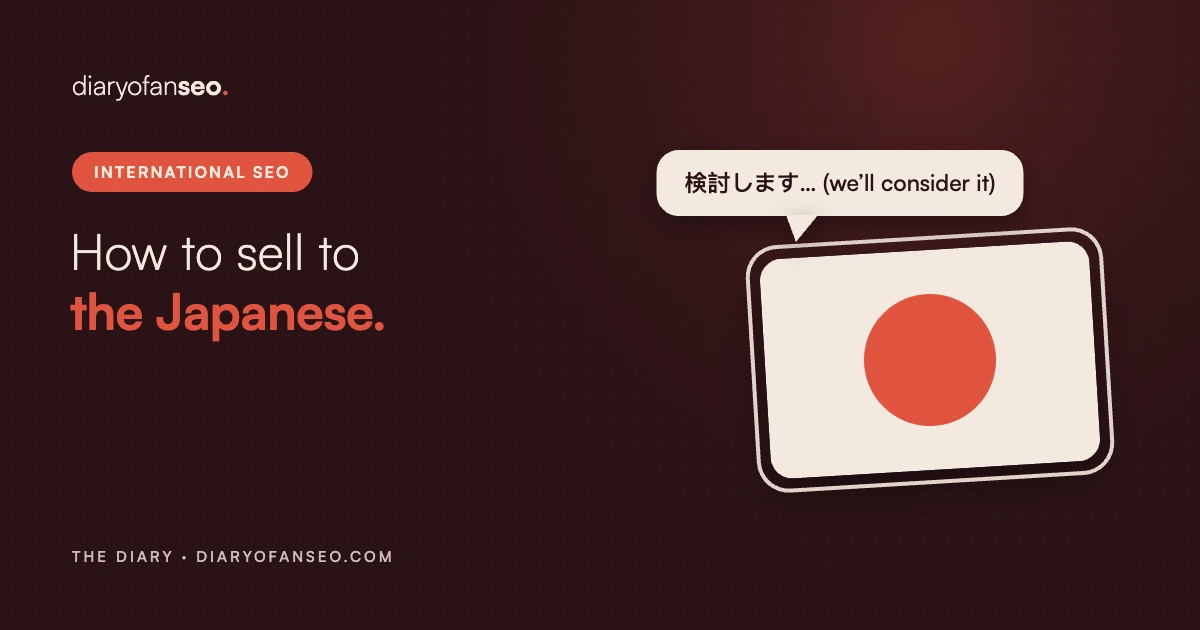
Here is a concrete example, widely reported by people who sell in Japan rather than measured in research. “Kentō shimasu” (“we will consider it”) or “chotto muzukashii desu” (“it is a little difficult”) often mean no. A British “we could do!” has a similar hidden meaning, but the Japanese version is even softer.
Modesty: why self-criticism sells
Psychologists Steven Heine and colleagues found that Japanese culture tends to value self-criticism and self-improvement, where North American culture tends to value seeing yourself positively (Heine and others, Psychological Review, 1999). For copy, a line like “We are the best agency in Japan” puts buyers off. “We have been working to improve [X] for 12 years, and here is what we have learnt” builds trust.
Writing website copy for Japan
Professional Japanese localisation
Japanese pages must be written or adapted by a professional native writer, not machine-translated. Japanese has several layers of polite language, known as keigo. These include respectful forms that raise the reader, humble forms that lower the writer, and polite forms for neutral courtesy. Linguist Sachiko Ide showed that choosing the right form in Japanese is a social obligation, decided by the relationship, rather than a personal style choice (Ide, Multilingua, 1989). In practice, customers are usually addressed as “okyakusama” (the honoured customer), and your own company speaks humbly. Getting this wrong reads like a stranger using your first name.
Structure: detail is a feature
In our experience, Japanese business pages that convert are long and well organised. They include a clear summary, then specifications, process steps, pricing, FAQs, company information and downloadable PDFs for colleagues. Use clear headings so the detail is easy to scan. The W3C publishes detailed requirements for Japanese text layout, including line-breaking rules, which your designer and developer should follow (W3C, Requirements for Japanese Text Layout).
Humour and tone
Keep humour gentle or leave it out. Puns and cultural references from English rarely survive translation. Calm, polite, specific copy is the safe default.
The proof Japanese buyers look for
Local presence and company information
Online sellers in Japan must show their legal name, a real business address and a phone number that reliably reaches them. For companies advertising online, they must also show the name of the representative or the person responsible. These details must be easy to find from the top page, typically through a page labelled as the disclosures required under the Specified Commercial Transactions Act (Consumer Affairs Agency, mail order advertising). Even if you only sell services to businesses, a detailed company profile page is expected, in our experience.
Trust in foreign firms
The 2026 Edelman Trust Barometer found that people in Japan trust domestic companies 29 points more than foreign ones (Edelman, 2026). As a foreign firm, you start behind. Japanese clients, Japanese partners and a Japanese contact point close the gap.
Reviews and endorsements
Since 1 October 2023, advertising that hides the fact that it is advertising (“stealth marketing”) breaks the Act against Unjustifiable Premiums and Misleading Representations. Sponsored posts must be clearly labelled, for example as “PR” or “advertisement” (Consumer Affairs Agency, stealth marketing). Any incentive behind a review or testimonial must be clear.
Privacy pages
Japan’s Act on the Protection of Personal Information (APPI) says a business must promptly tell people the purpose of use when it collects their personal information, or make that purpose public, unless it is already public (APPI, Article 21). Most businesses do this with a clear Japanese privacy policy linked from every form.
No Japanese clients yet? Building proof from scratch
With a 29-point trust advantage for domestic firms, having no Japanese clients is a real limit, especially with large companies. It is a starting point, not a verdict. Here is how to begin:
- Present overseas work with care. Translate case studies properly, include detailed method and numbers, and explain why they are relevant to Japan.
- Partner locally. A Japanese distributor, reseller or agency partner lends you their reputation, which matters in a culture built on long-term relationships.
- Show staying power. Years in business, company history and a Japanese contact point reassure a long-term-oriented buyer.
- Start small and safe. A clearly scoped paid pilot, with written goals and an easy exit, suits very high Uncertainty Avoidance.
- Earn your first case study openly. Offer early clients a pilot rate in return for an honest case study, and label any sponsored content, in line with the stealth marketing rules.
- Be humble on the page. “New to Japan. Here is what we have done elsewhere, and how we will support you” fits the modesty research.
Pricing pages: consumption tax, shown properly
Japan has consumption tax rather than VAT. The standard rate is 10%. A reduced rate of 8% applies to some food and drink and to some newspaper subscriptions (National Tax Agency). Since April 2021, businesses must show the tax-inclusive total when they display prices in advance to consumers, for example on websites, adverts and price tags. This does not apply to businesses exempt from consumption tax, or to sales made exclusively to other businesses (Ministry of Finance, total price display guidelines; National Tax Agency, total price display). Accepted formats include “11,000円(税込)” and “11,000円(税抜価格10,000円)”. Showing only the pre-tax price to consumers is not acceptable.
A business is generally exempt from consumption tax if its taxable sales in the base period were 10 million yen or less. It becomes taxable if it chooses to, or if it registers as a qualified invoice issuer (National Tax Agency). Check your position with an adviser.
If you sell services
Show clear packages with tax-inclusive prices for consumers, and say exactly what is included. For business clients, many Japanese firms expect a formal quotation document. A downloadable sample quote helps your contact get internal approval, in our experience.
If you sell products
Mail order rules say that if shipping is not included in the price, you must show the specific amount. “Shipping at cost” is not acceptable. The Consumer Affairs Agency’s own examples show prices by region, from Hokkaido to Okinawa, and you must also state delivery timing, payment methods, other charges such as cash-on-delivery fees, and your returns policy (Consumer Affairs Agency). In our experience, remote islands and the far north and south can cost more and take longer, so be upfront about it.
For cross-border sellers, Japan Customs generally exempts imports with a total customs value of 10,000 yen or less from customs duty and consumption tax. There are exceptions, such as some leather bags, knitwear and leather shoes (Japan Customs). Above that, say clearly who pays duty and tax on delivery.
When a buyer quotes a cheaper competitor
This scenario is from practitioner experience. A Japanese buyer politely mentions that a domestic supplier is cheaper. If it is true and you cannot match it, say so calmly, and explain in detail what your price includes. If the other option genuinely fits them better, say that too. Honesty and long-term thinking are respected, and the relationship may come back later.
From CTA to booked call
Low pressure, easy exit
Buyers who feel comfortable and know they can leave easily are more likely to go ahead. In Japan, pressure tends to end the conversation. Offer low-commitment steps, such as downloading a document, asking a question or booking a short consultation, and say clearly that there is no obligation.
Forms and booking pages
In our experience, Japanese forms usually ask for the company name, department and name, with a reading in kana. Keep the form short anyway. Add a separate box for marketing email. The Consumer Affairs Agency’s guidelines recommend leaving it unticked by default.
CTAs
“資料をダウンロード” (download materials) or “お問い合わせ” (contact us) suit early-stage buyers. A meeting request works better once they have the detail they need.
Follow-up emails: opt-in by law
Japan’s Act on Regulation of Transmission of Specified Electronic Mail uses an opt-in model. You need prior consent before sending advertising email, with limited exceptions. These include people who gave you their email address in writing, for example on a business card, people with whom you have a business relationship, and organisations that publish their own email address. The Consumer Affairs Agency’s guidelines say you should keep records of consent, recommend double opt-in, and require each email to show the sender’s name, address, an opt-out address and a contact point (Consumer Affairs Agency, specified email guidelines). A good follow-up thanks them, attaches the promised material, and leaves the next step to them.
Landing page copy: rewriting for Japan
These are illustrative examples, not tested copy, and any Japanese text must be written by a native professional. Square brackets mark details to replace.
| Element | Generic UK or US version | Japan rewrite (illustrative, shown in English) | Why |
|---|---|---|---|
| Hero headline | The world’s best SEO agency | Helping international companies be found in Japan, carefully and step by step | Self-criticism over self-enhancement (Heine and others, 1999). |
| Subhead | Fast results, guaranteed | A clear process, monthly reports and a dedicated contact, since [2014] | Very high Uncertainty Avoidance and Long Term Orientation (The Culture Factor). |
| “Competitive pricing” | From ¥100,000 + tax | From ¥[110,000] a month (tax included) | Tax-inclusive totals for consumers (Ministry of Finance). |
| CTA button | Book a demo now! | Download our service guide (PDF) | Buyers want all the facts first (The Culture Factor). |
| Guarantee | Risk-free! | A three-month pilot with agreed goals. You can stop after the pilot. | Clear terms reduce uncertainty (The Culture Factor). |
| Social proof | Loved by 500 brands | Case study: how a [UK manufacturer] grew enquiries from Japan, with full method | Detail and honesty build trust (Meyer; Edelman). |
| Shipping line | Shipping calculated at checkout | Shipping: ¥[800] (Honshu), ¥[1,500] (Hokkaido, Okinawa). Ships within [3] business days. | Specific amounts and timing required (Consumer Affairs Agency). |
| Company details | About us | Company profile and legal disclosures: name, address, phone, representative | Required for online sellers (Consumer Affairs Agency). |
Sample hero opener (illustrative, to be written in Japanese by a native copywriter):
- Headline: Be found by the right customers in Japan.
- Subhead: Search marketing for international companies, with a clear process, Japanese-language support and prices that include tax.
- CTA button: Download our service guide
Japan vs the UK vs the US at a glance
| Japan | United Kingdom | United States | |
|---|---|---|---|
| Uncertainty Avoidance (Culture Factor) | 92 | 35 | 46 |
| Long Term Orientation (Culture Factor) | 100 | 60 | 50 |
| Achievement and Success (Culture Factor) | 95 | 66 | 62 |
| Communicating (Meyer) | Highest context | Low context, with understatement | Lowest context |
| Sales tax on consumer prices | 10% consumption tax (8% reduced), total shown | VAT included | Sales tax usually added at checkout |
| Marketing email | Opt-in | Stricter for individuals than for corporate subscribers (PECR) | Opt-out (CAN-SPAM) |
Sources: The Culture Factor; Meyer keynote slides; National Tax Agency. UK and US rows draw on our British and American guides.
Running the sales call
Prepare more than you think you need, and send materials beforehand so people can read in advance. Expect several attendees and few questions on the call. Questions often arrive later by email, after internal discussion. Do not push for a decision. Summarise in writing, in Japanese, and ask what information would help their internal review. Silence is usually thinking, not rejection.
FAQs
Can I sell in Japan with an English website?
Some international business buyers will read English. Most Japanese buyers expect professional Japanese pages, and correct keigo signals that you take them seriously.
Do prices on my Japanese site have to include consumption tax?
For consumers, yes, if you are a taxable business. The rule does not apply to tax-exempt businesses or to sales made only to other businesses.
Is cold emailing allowed in Japan?
Advertising email generally needs prior opt-in consent, with limited exceptions such as addresses received on a business card or published by an organisation.
What about meeting in person?
Arrive early, bring plenty of business cards and exchange them respectfully, and let the most senior person lead. Expect the first meeting to be about understanding each other.
Getting it right in Japan, one step at a time
Japan rewards patience, so we work in stages rather than all at once.
First, we listen to the market
We research how Japanese buyers search for what you offer, in Japanese, and compare it with how your current pages are written. You get a clear picture of where the opportunity is, and where your site is losing people.
Then, we shape the pages
We plan the structure, detail and URLs of your Japanese pages, ready for your native copywriter, and set them up so search engines show the right language to the right person. Our thinking on cultural compartmentalisation keeps Japan distinct from your other markets.
Finally, we build steadily
With SEO for one country, we grow your visibility in Japan month by month, with reports your colleagues can share internally.
When you are ready, request a consultation. We will take the time to understand your situation first.
Planning to sell to Japanese buyers? As a UK international SEO agency, we help brands get found by them in search and in AI answers, then turn that visibility into enquiries.
References
- The Culture Factor Group. “Country Comparison Tool” (Japan, United Kingdom, United States). The Culture Factor, accessed 31 October 2026. https://www.theculturefactor.com/country-comparison-tool?countries=japan%2Cunited+kingdom%2Cunited+states
- Hall, E. T. Beyond Culture. Anchor Press/Doubleday, 1976. https://openlibrary.org/books/OL21335737M/Beyond_culture
- Meyer, E. The Culture Map: Breaking Through the Invisible Boundaries of Global Business. PublicAffairs, 2014. https://erinmeyer.com/books/the-culture-map/
- Meyer, E. “The Culture Map” keynote slides (country positions on the eight scales). TFWA, 2023. https://www.tfwa.com/sites/tfwa.com/files/2023-10/Erin%20Meyer.pdf
- Heine, S. J., Lehman, D. R., Markus, H. R. and Kitayama, S. “Is there a universal need for positive self-regard?” Psychological Review, 106(4), 766 to 794, 1999. https://doi.org/10.1037/0033-295X.106.4.766
- Ide, S. “Formal forms and discernment: two neglected aspects of universals of linguistic politeness.” Multilingua, 8(2-3), 223 to 248, 1989. https://doi.org/10.1515/mult.1989.8.2-3.223
- W3C. “Requirements for Japanese Text Layout.” W3C, n.d. https://www.w3.org/TR/jlreq/
- Consumer Affairs Agency. “Advertisements for Mail Order Sales.” Guide for Specified Commercial Transactions Act, n.d. https://www.no-trouble.caa.go.jp/foreignlanguage/english/mailorder/advertising.html
- Edelman. “2026 Edelman Trust Barometer: Japan and Global Report.” Edelman, 2026. https://www.edelman.com/sites/g/files/aatuss191/files/jp/2026-05/2026%20Edelman%20Trust%20Barometer%20Japan%20and%20Global%20Report.pdf
- Consumer Affairs Agency. “From 1 October 2023, stealth marketing violates the Act against Unjustifiable Premiums and Misleading Representations” (in Japanese). CAA, 2023. https://www.caa.go.jp/policies/policy/representation/fair_labeling/stealth_marketing
- Government of Japan. “Act on the Protection of Personal Information” (English translation). Japanese Law Translation, n.d. https://www.japaneselawtranslation.go.jp/en/laws/view/4241/en
- National Tax Agency. “Basic knowledge: consumption tax.” NTA, n.d. https://www.nta.go.jp/english/taxes/consumption_tax/01.htm
- Ministry of Finance. “Guidelines on total price display” (in Japanese). MOF, 2021. https://www.mof.go.jp/tax_policy/summary/consumption/210107guideline_sougaku.pdf
- National Tax Agency. “No. 6902: Mandatory total price display” (in Japanese). NTA, n.d. https://www.nta.go.jp/taxes/shiraberu/taxanswer/shohi/6902_qa.htm
- Japan Customs. “1006 Duty exemption for goods at a total customs value of 10,000 yen or less (FAQ).” Japan Customs, n.d. https://www.customs.go.jp/english/c-answer_e/imtsukan/1006_e.htm
- Consumer Affairs Agency. “Guidelines on the Transmission of Specified Electronic Mail” (in Japanese). CAA, 2011. https://www.caa.go.jp/policies/policy/consumer_transaction/specifed_email/pdf/110831kouhyou_2.pdf