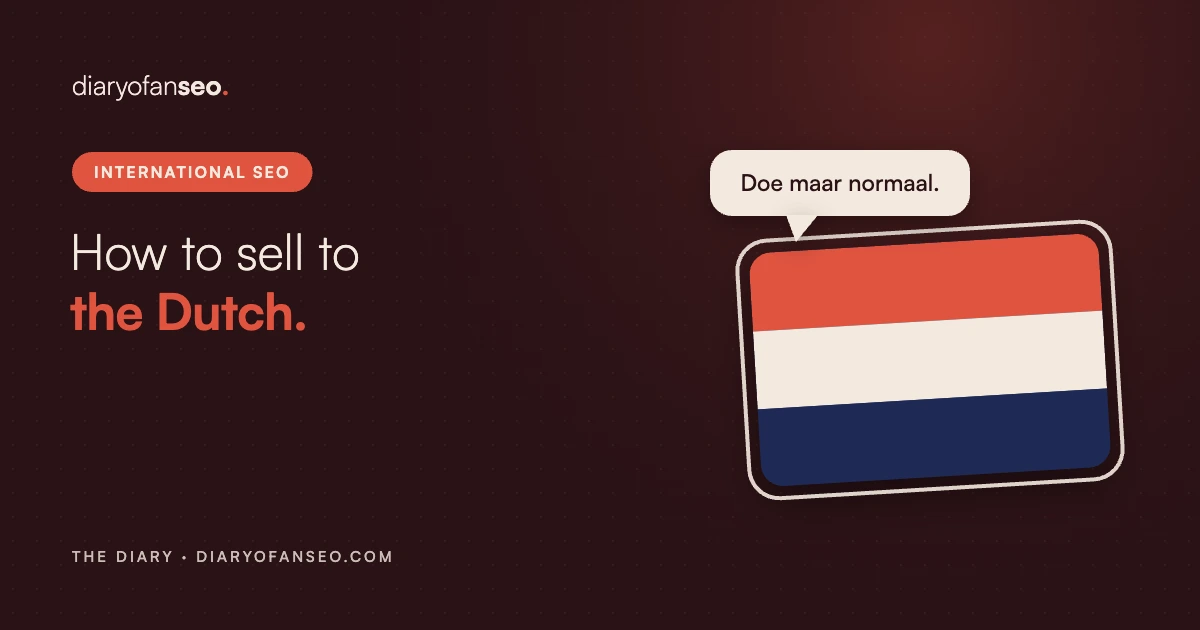
A Dutch visitor reads “We’re the world’s most innovative platform!” on your homepage and feels sold to, not excited. There is a Dutch saying for this moment: “doe maar normaal, dan doe je al gek genoeg”, roughly “just act normal, that’s crazy enough” (BNNVARA). It means: be modest, don’t put yourself above others. Your copy needs to pass that test.
This guide covers selling to Dutch buyers through your website: wording, proof, prices and tax, and getting visitors onto a sales call. As in our guides to selling to the British and selling to Americans, we separate research from our own experience, and we split the practical advice for service businesses and product businesses where it differs.
A quick note on names. The country is the Netherlands. Holland is a region within it (North and South Holland), and since 2020 the Dutch government has promoted “the Netherlands” rather than “Holland” abroad (The Guardian). The people and the language are Dutch. We use those names throughout.
What the research says about Dutch buyers
Hofstede’s model, now published by The Culture Factor, scores countries from 0 to 100 on six dimensions, based on large surveys about work and life values. Scores only mean something in comparison. Three matter here (The Culture Factor):
- Power Distance (how much people accept hierarchy): the Netherlands scores 38. Hierarchy is “for convenience only” and communication is “direct and participative”. In practice, buyers don’t need a senior title to trust you; they want a useful answer.
- Motivation towards achievement (once called Masculinity): the Netherlands scores 14, one of the lowest anywhere. Low means consensus and quality of life matter more than winning. In practice, “dominate your market” copy falls flat; “work calmer, finish on time” lands better.
- Uncertainty Avoidance (how uncomfortable people are with the unknown): 53, a slight preference for rules. In practice, buyers want clear terms but will try something new if it is explained plainly.
The Netherlands also scores 100 on Individualism, the model’s highest: people decide for themselves.
Erin Meyer’s Culture Map, by the INSEAD professor, places countries on eight scales of business behaviour. Two matter here (Erin Meyer):
- Communicating: the Netherlands sits at the “low context” end. Meyer’s definition: good communication is “precise, simple, explicit, and clear” and messages are “understood at face value”. In practice, a Dutch reader takes your words literally. If you write “fast onboarding”, they will ask “how fast?”
- Disagreeing: Meyer lists the Netherlands among countries “quite comfortable having spirited, confrontational meetings”. In practice, a prospect who calls your pricing page confusing is helping, not being rude.
How to write website copy for Dutch readers
Dutch or English?
The Netherlands ranked first of 123 countries and regions in the 2025 EF English Proficiency Index (EF EPI). So English pages can work, especially for B2B tech. But speaking English well is not the same as preferring to buy in it. A study of product adverts in five countries, including the Netherlands, found that a large share of English phrases were not correctly understood, whatever level of English people claimed (Gerritsen et al., 2010). In our experience, Dutch versions of your key pages (home, pricing, contact, checkout, terms) earn more trust, especially with consumers and traditional sectors.
Je or u?
Dutch has an informal “you” (je, jij) and a formal one (u). In our experience, most Dutch consumer brands and many B2B software companies now write with “je”, which matches the low Power Distance score. Legal, financial and healthcare services often keep “u”. Pick one and use it everywhere, including in automated emails. Mixing them reads as careless.
Say it plainly, then prove it
Low context readers want the facts in the sentence itself. Compare:
- Vague: “Flexible plans that grow with you.”
- Dutch-friendly: “Vanaf € 29 per maand, inclusief btw. Maandelijks opzegbaar.” (From €29 a month, including VAT. Cancel any month.)
Modesty versus self-promotion
Here many British and American sites go wrong: big claims raise suspicion. What puts Dutch buyers off, in our experience:
- Superlatives with no proof: “the best”, “world-class”, “revolutionary”.
- Exclamation marks and hype: “Don’t miss out!!!”
What works instead is the confident fact, for example (illustrative): “312 accountancy firms in Belgium and Germany use us. Average set-up time: two days.” Let the numbers do the boasting.
Proof and trust signals Dutch buyers look for
Company details on the page
If you sell online to Dutch customers, the government’s business portal says your website must show your KVK number (from the Dutch Chamber of Commerce register), along with your company name, address, email address, phone number and VAT identification number, easy to find before purchase (Ondernemersplein). The KVK rule applies to businesses registered in the Netherlands. If you are registered elsewhere, show your own registration details just as clearly. A footer with full details is one of the cheapest trust signals you can add.
Reviews
Use whichever recognised review platform suits your sector, and show real, recent reviews. EU consumer law, updated by the Omnibus Directive, treats fake reviews as an unfair practice and requires you to say whether and how you check that reviews come from real customers (Directive (EU) 2019/2161).
Data protection and cookies
The Dutch Data Protection Authority (Autoriteit Persoonsgegevens) says refusing cookies must be as easy as accepting them, on the same layer of the banner, with no extra clicks or hidden links (Autoriteit Persoonsgegevens). Publish a privacy policy in Dutch that explains what you collect and why.
Pricing pages and the tax rules
The Netherlands has a VAT, called btw (belasting over de toegevoegde waarde). The standard rate is 21%, with a 9% rate for a limited list of goods and services such as food, books and hairdressing (Belastingdienst).
- Consumers (B2C): the first price you show must be in euros, include btw and include all unavoidable costs, such as compulsory shipping, admin or service fees. Optional extras can be shown separately (ACM).
- Businesses (B2B): the consumer rules don’t apply, and in our experience Dutch B2B buyers expect prices “excl. btw”, clearly labelled. If both audiences use one page, show both.
- Small Dutch businesses not charging VAT: under the small business scheme (kleineondernemersregeling, KOR), Dutch businesses with turnover up to €20,000 a year can stop charging btw. Their invoices must not show a VAT rate or amount and should state that an exemption applies (Belastingdienst). On a price list, say “geen btw” (no VAT) so nobody expects a VAT line.
- Selling in from another EU country: for goods sent to consumers in other EU countries, a single €10,000 a year EU-wide threshold applies. Above it, you charge the customer’s country’s VAT, usually through the One Stop Shop (European Commission).
- Caribbean Netherlands: Bonaire, Sint Eustatius and Saba do not use btw. They have a separate tax, the ABB (algemene bestedingsbelasting), at different rates (Belastingdienst Caribisch Nederland). If you do not serve those islands, say so in your delivery terms.
For service businesses
Show a starting price or typical range; in our experience Dutch buyers are impatient with “contact us for pricing”. If prices vary, say what drives them, for example: “A website for a five-person firm usually costs €4,000 to €7,000 excl. btw, depending on the number of pages and languages.”
For product businesses
Payment and delivery are part of the price story. iDEAL, the Dutch bank payment method, accounted for 72% of Dutch online purchases in 2024 (Betaalvereniging Nederland). For delivery, the Wadden Islands (Texel, Vlieland, Terschelling, Ameland and Schiermonnikoog) work differently. PostNL’s business terms say parcels to the islands are not delivered on Mondays, guaranteed time-slot and Sunday delivery are not available there, and pallet freight to the islands carries a surcharge (PostNL). If your courier charges extra or takes longer for the islands, say so on the product page, not at the last step. Do the same for longer lead times from abroad.
Forms, contact and booking pages
Ask only for what you need. Data minimisation is a GDPR principle (GDPR, article 5), and short forms suit readers who want a straight exchange. Make the phone field optional. Under the form, say what happens next: who will reply, in which language and how fast.
CTAs and the path to a sales call
Dutch buyers like to decide for themselves (that Individualism score of 100), so a pushy CTA backfires. The word to know is “vrijblijvend”, meaning “without obligation”. In our experience, a call booked “vrijblijvend” with a clear end time gets more takers than “Book your strategy session now!”
Good Dutch CTAs, in our experience:
- Say exactly what happens: “Plan een gesprek van 20 minuten” (Book a 20 minute call).
- Give an easy exit: “Geen verkooppraatje. Past het niet, dan zeggen we dat.” (No sales pitch. If it’s not a fit, we’ll say so.)
- Offer a secondary, lower-commitment option, such as a price list or a demo video, for people not ready to talk.
In our experience, buyers who feel no pressure and know they can leave are more likely to say yes.
Follow-up emails and consent
The Dutch rules on marketing email sit in the Telecommunications Act (Telecommunicatiewet, article 11.7), alongside GDPR (Telecommunicatiewet). In short (ACM):
- Consumers and individuals, including sole traders and freelancers: you need prior consent (opt-in).
- Existing customers: you may email them about your own similar products or services, if you offered a free, simple opt-out when you collected their address and in every email.
- Legal entities such as BVs: the rules are less strict for an address the company itself has published for receiving such messages, but you must still offer an opt-out, and a named person’s work address is still personal data under GDPR. If in doubt, treat it like a consumer address and ask for consent.
A factual recap after a sales call, with price and next step, is a follow-up, not marketing. Keep it that way.
Running the sales call
Keep video calls short and structured: agenda, questions, recommendation, price. Expect direct questions such as “Why are you more expensive than [competitor]?” Answer directly.
Honesty can win here. A scenario we see often: a prospect says a competitor quoted 30% less. If that is true and you cannot match it, say so. Explain what the difference buys, and if the cheaper option genuinely suits them better, tell them. In our experience, Dutch buyers remember that, and some come back when their needs grow. Recap in writing afterwards: decisions are often made by consensus and your recap gets shared.
No Dutch clients yet? What that means and what to do
“We have no Dutch clients or reviews yet. Does that stop us?” No. It is a stage. The limit is real: visitors can’t see anyone like them who has used you, so your page must work harder on clarity and fairness.
- Use the proof you have, labelled honestly. Translate case studies from other markets into Dutch and keep the client’s country visible: “Klant in België” (Client in Belgium). Numbers travel well; adjectives do not.
- Show local reachability. A Dutch phone number or Dutch-speaking contact, full company details in the footer, and your VAT number. If you’re based elsewhere, say so.
- Make the risk smaller. A monthly contract, a free trial, or a short paid pilot with a clear exit fits a culture that values fair deals.
- Recruit founding clients. Offer a small group of first Dutch clients a lower price for honest, published reviews, and say that they received a discount.
- Borrow credibility. Membership of a relevant Dutch trade association or bilateral chamber of commerce, or a Dutch partner, gives visitors a local reference point.
- Say you’re new. “Nieuw in Nederland” with one line on why you came reads as straightforward. That candour is itself a trust signal.
Landing page copy: the Dutch way to say it
Eight common landing page lines adapted for Dutch buyers, with English glosses, for an imaginary project management tool for agencies.
| Landing page element | Generic English version (illustrative) | Dutch adaptation (illustrative) | Why it works in the Netherlands |
|---|---|---|---|
| Hero headline | “The #1 project tool loved by agencies worldwide!” | “Projecten op tijd af, zonder extra overleg” (Projects finished on time, without extra meetings) | A plain benefit beats a superlative (BNNVARA). |
| Body opener | “Unlock your team’s full potential!” | “Planning, uren en facturen in één overzicht. Je team ziet wat er vandaag moet gebeuren.” (Planning, hours and invoices in one view. Your team sees what needs doing today.) | Low context readers want the function, not a metaphor (Erin Meyer). |
| Pricing line | “Plans for every budget!” | “€ 9 per gebruiker per maand, excl. btw. Maandelijks opzegbaar.” (€9 per user a month, excl. VAT. Cancel any month.) | A clear B2B price; consumer pages must include btw (ACM). |
| Primary CTA | “Book your strategy session now!” | “Plan een vrijblijvend gesprek van 20 minuten” (Book a 20 minute call, no obligation) | Time limit and no obligation respect the buyer’s choice (practitioner observation). |
| Secondary CTA | “Get started” | “Bekijk eerst de demo van 3 minuten” (Watch the 3 minute demo first) | A low-pressure step for visitors not ready to talk (practitioner observation). |
| Social proof | “Trusted by industry leaders!” | “Gebruikt door 140 bureaus in België en Duitsland. Nog nieuw in Nederland.” (Used by 140 agencies in Belgium and Germany. Still new in the Netherlands.) | Specific, honest numbers; reviews must be genuine (Directive (EU) 2019/2161). |
| Booking form intro | “Fill in the form and we’ll be in touch!” | “Drie velden. Je krijgt binnen één werkdag antwoord, in het Nederlands.” (Three fields. You’ll get a reply within one working day, in Dutch.) | Minimal data (GDPR, article 5) and a clear next step. |
| Trust line | “A passionate global team” | “[Bedrijfsnaam], KVK [nummer], btw-id [nummer]. Bel ons: [nummer].” ([Company name], KVK [number], VAT ID [number]. Call us: [number].) | Expected, and required for Dutch-registered sellers (Ondernemersplein). |
Sample hero (illustrative)
Projecten op tijd af, zonder extra overleg.
Planning, uren en facturen in één overzicht voor bureaus tot 50 mensen. € 9 per gebruiker per maand, excl. btw. Maandelijks opzegbaar.
[Plan een vrijblijvend gesprek van 20 minuten] [Bekijk de demo]
(Projects finished on time, without extra meetings. Planning, hours and invoices in one view for agencies of up to 50 people. €9 per user a month, excl. VAT. Cancel any month. [Book a 20 minute call, no obligation] [Watch the demo])
The Netherlands vs UK vs US at a glance
| Netherlands | United Kingdom | United States | |
|---|---|---|---|
| Power Distance (Culture Factor) | 38 | 35 | 40 |
| Achievement motivation (Culture Factor) | 14 | 66 | 62 |
| Uncertainty Avoidance (Culture Factor) | 53 | 35 | 46 |
| Communication (Meyer) | Low context, explicit | Low context, with understatement | Low context, explicit |
| Copy tone that suits it | Plain, factual, modest | Understated, practical | Confident, outcome first |
Sources: The Culture Factor; Erin Meyer; For the UK and US rows, see our British and American guides.
Common mistakes when selling to the Dutch
- Translating hype word for word: “revolutionair” sounds odd in Dutch.
- Hiding prices, or showing consumer prices without btw.
- A cookie banner with a big “Accept” and a hidden “Reject”.
- Calling the country “Holland” in formal copy aimed at people outside North and South Holland.
- Surprise delivery costs or island delays revealed at the final step.
Practical checklist
- Dutch key pages, with one form of address (“je” or “u”) throughout.
- Prices in euros: incl. btw for consumers, clearly marked excl. btw for businesses, or “geen btw” if you are exempt.
- Full company details in the footer, and iDEAL at checkout for consumers.
- Delivery costs and lead times shown on product pages, including any extra cost or delay for the Wadden Islands.
- A short form with a stated reply time, a “vrijblijvend” CTA and a low-pressure second option.
- Opt-in consent for marketing email to individuals and sole traders.
FAQs
Can I sell to the Dutch with an English website?
You can, especially in B2B tech, because English proficiency is very high (EF EPI). But research shows English copy is often misunderstood even by confident speakers (Gerritsen et al., 2010). At minimum, put pricing, terms, privacy and checkout in Dutch.
Should I show prices with or without btw?
For consumers, always with btw and all unavoidable costs (ACM). For business buyers, excl. btw is normal in our experience, but label it clearly.
Anything I should know if we meet in person?
Be on time and come prepared. In our experience, Dutch first meetings move to business within minutes, with little small talk. That is the whole etiquette lesson.
Can I email Dutch business contacts who download a guide?
Only with clear opt-in consent if the contact is an individual, including freelancers and sole traders (ACM). Put an unticked consent box on the form and an opt-out in every email.
Gewoon goed: what “normal” looks like on a Dutch website
The best Dutch websites we see are not clever. They are clear: a plain promise, a real price, full company details, iDEAL at checkout and a call that you can book without being chased.
Before you launch, we check:
- Whether your claims would pass the “doe maar normaal” test.
- That your prices follow the btw rules for the audience you sell to.
- What Dutch buyers actually search for, rarely a translation of your English keywords.
- Whether your forms, consent boxes and cookie banner meet Dutch expectations.
Want a second pair of eyes on your Dutch pages, or help choosing search terms? Talk to us. Plain answers, no pressure, and we’ll tell you if it’s not a fit.
Planning to sell to Dutch buyers? As a UK international SEO agency, we help brands get found by them in search and in AI answers, then turn that visibility into enquiries.
References
- The Culture Factor. “Country comparison tool” (Netherlands, United Kingdom, United States). https://www.theculturefactor.com/country-comparison-tool
- Meyer, E. “Team Mapping Tool Report” (The Culture Map scales). https://erinmeyer.com/team-culture-mapping-report/
- BNNVARA. “‘Doe maar normaal, dan doe je al gek genoeg’: waar komt die uitspraak vandaan?” https://www.bnnvara.nl/artikelen/doe-maar-normaal-dan-doe-je-al-gek-genoeg-waar-komt-die-uitspraak-vandaan
- The Guardian. “Dutch government ditches Holland to rebrand as the Netherlands.” 4 October 2019. https://www.theguardian.com/world/2019/oct/04/holland-the-netherlands-dutch-government-rebrand
- EF Education First. “EF English Proficiency Index 2025: Netherlands.” https://www.ef.com/wwen/epi/regions/europe/netherlands/
- Gerritsen, M., Nickerson, C., van Hooft, A., van Meurs, F., Korzilius, H., Nederstigt, U., Starren, M. and Crijns, R. “English in Product Advertisements in Non-English-Speaking Countries in Western Europe: Product Image and Comprehension of the Text.” Journal of Global Marketing, 23(4), 349 to 365, 2010. https://doi.org/10.1080/08911762.2010.504523
- Ondernemersplein (Dutch government business portal). “Regels online verkoop.” https://ondernemersplein.overheid.nl/wetten-en-regels/regels-voor-online-verkoop/
- European Union. “Directive (EU) 2019/2161 (Omnibus Directive).” EUR-Lex. https://eur-lex.europa.eu/eli/dir/2019/2161/oj
- Autoriteit Persoonsgegevens. “Heldere cookiebanners.” https://autoriteitpersoonsgegevens.nl/themas/internet-slimme-apparaten/cookies/heldere-cookiebanners
- Belastingdienst. “Tarieven en vrijstellingen” (btw). https://www.belastingdienst.nl/wps/wcm/connect/bldcontentnl/belastingdienst/zakelijk/btw/tarieven_en_vrijstellingen/
- ACM (Authority for Consumers and Markets). “Prijzen vermelden.” https://www.acm.nl/nl/verkoop-aan-consumenten/consumenten-informeren/prijzen-vermelden
- Belastingdienst. “Wat betekent meedoen met de kleineondernemersregeling (KOR)?” https://www.belastingdienst.nl/wps/wcm/connect/bldcontentnl/belastingdienst/zakelijk/btw/hoe_werkt_de_btw/kleineondernemersregeling/wat-betekent-meedoen-met-de-kleineondernemersregeling/
- European Commission. “The One Stop Shop.” VAT e-Commerce. https://vat-one-stop-shop.ec.europa.eu/one-stop-shop_en
- Belastingdienst Caribisch Nederland. “ABB (algemene bestedingsbelasting particulieren).” https://www.belastingdienst-cn.nl/onderwerpen/belastingzaken-particulieren/abb-algemene-bestedingsbelasting-particulieren
- Betaalvereniging Nederland (Dutch Payments Association). “Online spending by Dutch consumers” (2024). https://www.betaalvereniging.nl/en/news/online-spending-2024/
- PostNL. “Service frameworks PostNL Pakketten Benelux BV / PostNL Transport BV.” https://www.postnl.nl/api/assets/blt43aa441bfc1e29f2/blt7468e5d9e0dd1147/service-frameworks-postnl-pakketten-benelux-bv-postnl-transport-bv/
- European Union. “Regulation (EU) 2016/679 (General Data Protection Regulation)”, article 5. EUR-Lex. https://eur-lex.europa.eu/eli/reg/2016/679/oj
- Telecommunicatiewet, article 11.7. wetten.overheid.nl. https://wetten.overheid.nl/BWBR0009950/
- ACM. “Spam.” https://www.acm.nl/nl/telecom/zakelijk-abonnement-voor-bellen-en-internet/spam