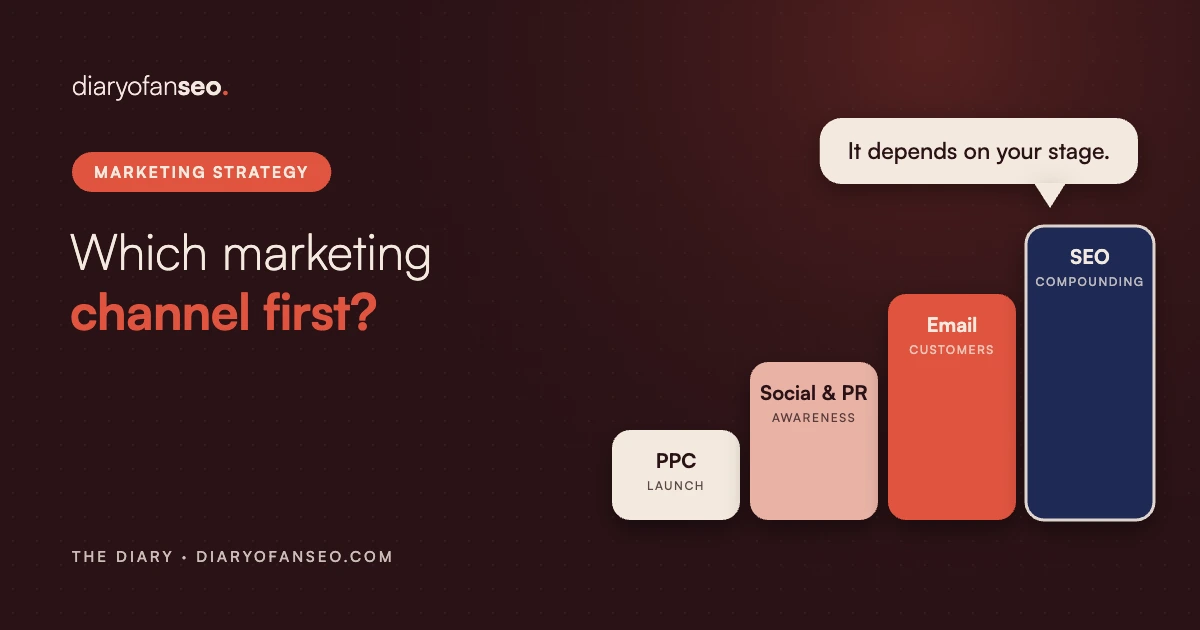
There’s obviously no single best marketing channel. There is a best channel for where your business is right now. If people already search for what you sell, paid search ads are usually the fastest way to your first sales. If they do not know your product exists yet, social media, PR, creators and word of mouth do the heavy lifting. Once you have customers, email and referrals become some of your cheapest wins. And once you can invest steadily for six to twelve months, SEO and content start to compound, often bringing your overall cost per customer down.
Yes, we are an SEO agency, and no, SEO is not always the right first move. Every figure below links to its source, and where the data is thin, we say so.
One caveat: benchmarks vary hugely by industry, country and how a “conversion” is defined. Use them as a sense check, not a target.
The quick summary
| Channel | Best stage | Speed to results | Cost profile | Typical conversion strength | Sources |
|---|---|---|---|---|---|
| Word of mouth and referrals | Every stage, especially early | Slow to build, then steady | Low cash, high effort | Very high trust | Nielsen, 2021 |
| Organic social (Instagram, TikTok, LinkedIn) | Pre-launch to early growth | Fast reach, unpredictable | Low cash, high time | Medium, better for B2C than B2B | First Page Sage, 2025 |
| PPC and Google Ads | Launch to scaling | Days | Pay per click, rising | Strong when people already search | WordStream/LocaliQ, 2026 |
| Paid social ads | Launch to scaling | Days | Pay per view or click | Strong for B2C, weaker for B2B | Unbounce, 2024 |
| SEO | Early growth onwards | 4 to 12+ months | Upfront investment, low cost per visit later | Strong, especially B2B | First Page Sage, 2025 |
| Content marketing | Early growth onwards | Months | Mostly time and people | Medium, supports other channels | First Page Sage, 2026 |
| Email marketing | Once you have a list | Immediate to your list | Very low per send | Highest of all traffic sources | Unbounce, 2024 |
| Influencers and affiliates | Early growth to scaling | Weeks | Fees or commission | Mixed, mostly awareness | Influencer Marketing Hub, 2026 |
| PR and digital PR | Launch and scaling | Weeks to months | Retainer or campaign | Low direct, high indirect | First Page Sage, 2025 |
| Partnerships | Early growth onwards | Months | Revenue share or time | Strong when audiences match | No reliable cross-industry benchmark |
| Events and trade shows | Any stage, mainly B2B | Immediate contacts | High per event | Low per visitor, high value contacts | First Page Sage, 2026 |
| Direct mail and print | Local and established businesses | Weeks | Print and postage | Good attention, low direct response | JICMAIL, 2024 |
| TV, radio and out-of-home | Scaling and established | Months to pay back fully | High minimum spend | Strong long-term profit at scale | Thinkbox/Ebiquity, 2024 |
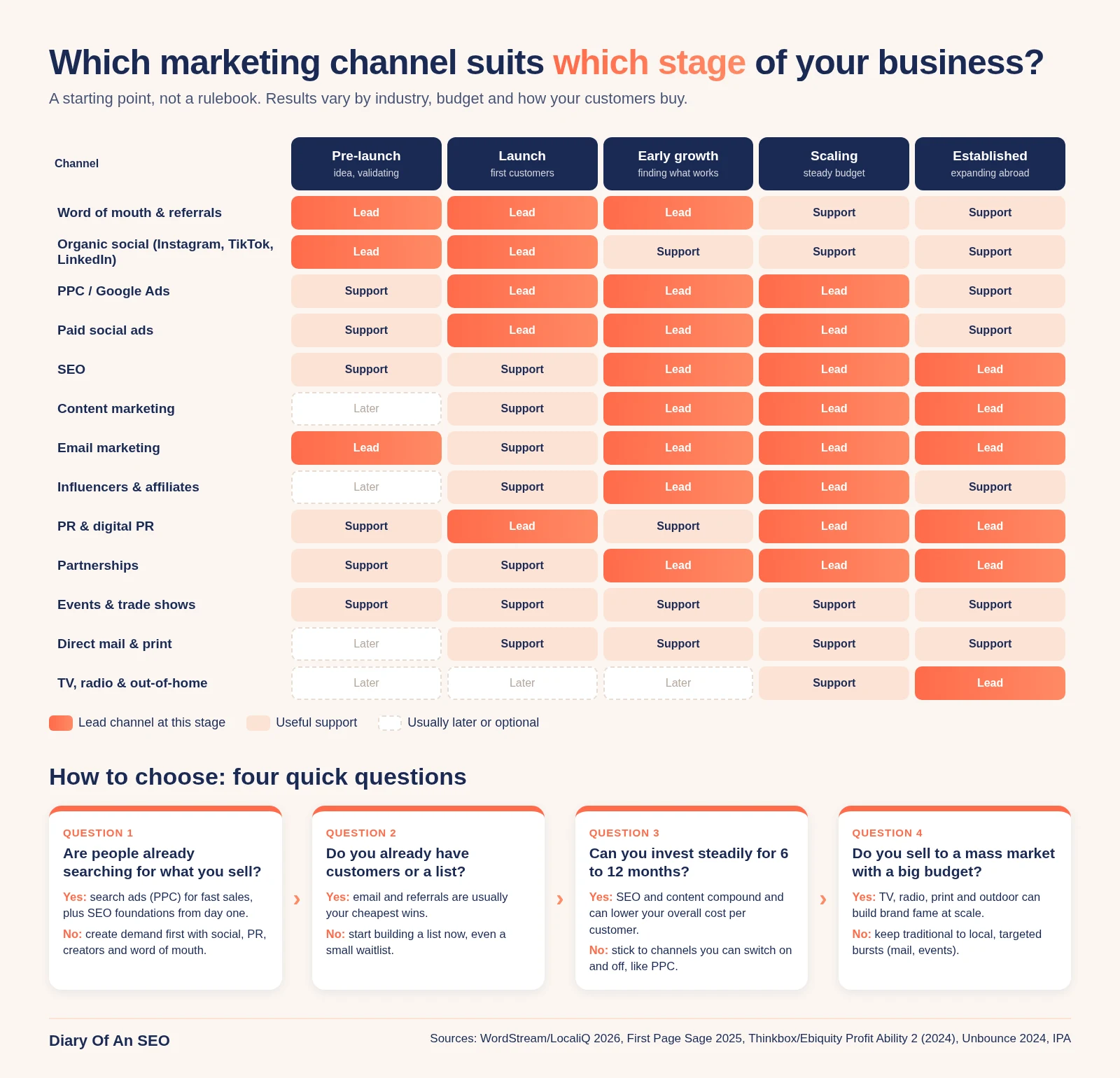
Stage by stage: what to focus on and when
1. Pre-launch or idea stage
Your job here is to find out whether anyone wants what you are building, and to gather a small group of people who do.
- Lead with: word of mouth, organic social and an email waitlist. They cost little cash, and they tell you quickly what people respond to.
- Useful support: a small paid test (search or social ads) to check whether demand exists before you build too much. If nobody searches for your product, that is a signal in itself.
- Start quietly: the basics of SEO, such as a sensible website structure and a domain you plan to keep. Ahrefs found that only 1.74% of newly published pages reached Google’s top 10 within a year, and that the average number one page is around five years old (Ahrefs, 2025). The clock starts the day you launch.
2. Launch or new business
You need customers now, and you probably have more time than money.
- Lead with: PPC (if people already search for what you sell), paid social (especially for consumer products), PR around the launch, and every personal network you have.
- Why PPC here: it is the quickest channel to switch on and off. First Page Sage puts the average time for PPC to break even at four months, against nine months for SEO (First Page Sage, 2025). In the UK, the Profit Ability 2 study found generic search ads delivered one of the highest short-term returns of any channel, £2.29 per £1 within the short-term window (Thinkbox/Ebiquity, 2024).
- The catch: PPC only captures demand that already exists. If your product is new to the world, nobody is typing it into Google yet, so social, PR and creators will do more for you.
3. Early growth
You have some customers and want repeatable, affordable growth.
- Lead with: email to your existing customers and enquiries, referral schemes, PPC and paid social you have already proven, and now a proper SEO and content plan.
- Why email now: in Unbounce’s analysis of 41,000 landing pages, visitors arriving from email converted at 19.3% on average, ahead of paid social (12%) and paid search (10.9%) (Unbounce, 2024).
- Why SEO now: this is usually the point where you can commit a steady budget, which is what SEO needs.
4. Scaling
You have a reliable budget and want to grow without costs per customer spiralling.
- Lead with: SEO and content, paid search and social at scale, influencers and affiliates, PR, and partnerships.
- Watch your blended cost: across First Page Sage’s B2B clients, organic channels averaged a $942 customer acquisition cost against $1,907 for paid channels (First Page Sage, 2026). For B2C the gap was much smaller ($480 against $319, so paid was actually cheaper on average), which is a useful reminder that the answer depends on what you sell.
- Brand matters more than it looks: the IPA’s long-running effectiveness research by Les Binet and Peter Field found the most effective campaigns split budgets roughly 60% brand building and 40% short-term sales activation, later updated to 62:38 (IPA, 2023). If everything you do is aimed at people ready to buy today, you will eventually run out of them.
5. Established and expanding internationally
You are protecting a position and opening new markets.
- Lead with: international SEO for each new country and language, content, email and retention, PR, partnerships, and, if your market is big enough, TV, radio and outdoor.
- Why international SEO: search is still the largest single source of trackable website traffic in most industries. BrightEdge found organic search drove 53.3% of trackable traffic on average, though this data is from 2019 and the share will have shifted since (BrightEdge, 2019). Each new country is effectively a new launch: paid ads to test demand, SEO to build lasting visibility.
- Why traditional media can now make sense: Profit Ability 2 found TV returned £5.61 in profit for every £1 over the full payback period, and print £6.36, but these returns come from businesses spending at scale (Thinkbox/Ebiquity, 2024).
Channel by channel: the honest pros and cons
Organic social (Instagram, TikTok, LinkedIn)
Pros: free to post, huge potential reach, and a real chance of something taking off. In Socialinsider’s 2025 data, brand TikTok posts averaged 6,496 views and a 3.70% engagement rate, against 3,403 views and 0.48% on Instagram (Socialinsider, 2026). HubSpot found marketers rate short-form video as the content format with the highest return (21% chose it) (HubSpot, 2025).
Cons: reach is rented from an algorithm you do not control, and it takes a lot of time. On conversion, the picture is more mixed than people assume. For B2B, organic social converted visitors at 1.7% against 2.6% for SEO. For B2C, organic social actually edged ahead, at 2.4% against 2.1% (First Page Sage, 2025). Social also sends relatively little website traffic: BrightEdge measured it at around 5% of trackable visits (BrightEdge, 2019).
Best for: building awareness and an audience, especially for visual and consumer products.
Paid social
Pros: precise targeting and fast feedback. Unbounce found Instagram ads (17.9%) and Facebook ads (13%) were the highest converting paid social sources to landing pages (Unbounce, 2024).
Cons: much weaker for B2B on average, converting at 0.9% against 2.1% for B2C (First Page Sage, 2025). Results stop when spending stops.
Best for: consumer products at launch and scale, and retargeting people who have already visited.
PPC and Google Ads
Pros: you reach people at the moment they are looking. Across 13,474 US search campaigns, the average conversion rate was 8.18% and the average cost per lead $66.69, ranging from $26.84 in arts and entertainment to $131.63 for legal services (WordStream/LocaliQ, 2026). WordStream suggests a typical small business starting budget of $1,000 to $2,500 a month (WordStream, 2026).
Cons: costs keep rising. The average cost per click has more than doubled since 2016, from $2.32 to $5.42 (WordStream/LocaliQ, 2026). Over three years, First Page Sage measured a 36% average return for PPC against 748% for SEO, because paid traffic never stops costing money (First Page Sage, 2025).
Best for: new businesses with some budget in markets where people already search, and for testing which messages and keywords sell before you invest in SEO.
SEO
Pros: once you rank, each visit costs you nothing extra. First Page Sage found SEO had the highest visitor-to-lead conversion rate of the main digital channels for B2B (2.6%) and a lower B2B acquisition cost than PPC ($647 against $802) (First Page Sage, 2025). It also builds an asset. Website brokers such as Empire Flippers note that some buyers avoid sites that rely on paid traffic altogether because ads need constant management (Empire Flippers, 2020).
Cons: it is slow, and it is getting harder to earn the click. Ahrefs found AI Overviews now reduce clicks to the top-ranking page by around 58% on the searches where they appear (Ahrefs, 2026), and SparkToro found 58.5% of US Google searches ended without a click at all (SparkToro, 2024). For consumer businesses, First Page Sage found SEO and PPC acquisition costs were almost identical ($298 against $290).
Best for: any business that can invest steadily for at least six to twelve months, especially B2B, considered purchases and international growth. If that is you, here is how our SEO for one country service works.
Content marketing
Pros: content feeds SEO, email, social and sales conversations at the same time.
Cons: it takes time, and many businesses struggle to make it work. Only 29% of B2B marketers rated their content strategy as very or extremely effective (Content Marketing Institute, 2025). First Page Sage put the B2B acquisition cost of general content marketing at $1,254, almost double “thought leadership” SEO content at $647 (First Page Sage, 2026).
Best for: early growth onwards, especially where buyers research before they buy.
Email marketing
Pros: the strongest converter of all traffic sources in Unbounce’s data (19.3%, and 28.6% for ecommerce) (Unbounce, 2024). In Litmus’s survey of marketing leaders, 35% reported returns of $10 to $36 for every $1 spent and 30% reported $36 to $50 (Litmus, 2025). You own the list, so no algorithm can take it away.
Cons: you need a list first, so email cannot win you your very first customers. Those return figures are self-reported by marketers.
Best for: every stage after your first few customers, and especially for repeat purchases.
Influencers and affiliates
Pros: borrowed trust and reach. In the UK, the affiliate industry body APMA estimated affiliate marketing generated £19bn in sales in 2024, with returns above 14:1 in every industry it measured (APMA, 2025). Affiliates are usually paid on results, which suits tight budgets.
Cons: in Influencer Marketing Hub’s 2026 survey, rising creator costs were the top challenge (35.4%), and fake or bot followers made up 56.5% of reported fraud issues. Brand awareness, not sales, was the most common measure of success (Influencer Marketing Hub, 2026).
Best for: consumer brands in early growth and scaling, with smaller creators and clear tracking codes.
PR and digital PR
Pros: credibility, reach, and links from respected websites, which also helps SEO.
Cons: hard to measure directly. First Page Sage found PR converted only 0.3% to 0.4% of visitors and had one of the highest B2B acquisition costs ($1,720) (First Page Sage, 2026). Its value is mostly indirect.
Best for: launches, funding news, new markets, and supporting SEO.
Word of mouth and referrals
Pros: the most trusted channel there is. Nielsen found 88% of people trust recommendations from people they know more than any other channel (Nielsen, 2021).
Cons: hard to scale on its own, and it depends entirely on how good your product and service really are.
Best for: every stage. A simple referral reward is often the cheapest marketing you will ever do.
Partnerships
Pros: another business’s audience, trust and distribution, often for a share of revenue rather than cash upfront.
Cons: slow to set up, and it only works when your audiences genuinely overlap. We could not find a reliable cross-industry benchmark for partnership results, so judge each deal on its own numbers.
Best for: early growth onwards, and especially when entering a new country with a local partner.
Traditional: print, radio, TV, out-of-home, events and direct mail
Pros: attention and long-term profit at scale. JICMAIL found the average piece of UK direct mail stays in the home for seven days, gets 133 seconds of attention and is interacted with 4.4 times; 6% of mail prompted a purchase (JICMAIL, 2024). Over the full payback period, Profit Ability 2 found print (£6.36), TV (£5.61) and audio (£4.98) returned more profit per £1 than generic search (£3.52) or paid social (£3.20) (Thinkbox/Ebiquity, 2024).
Cons: high minimum spend and slow, hard-to-track results. Measured by direct response, First Page Sage found direct mail (0.3% B2B), outdoor (0.6% B2B) and trade shows (0.7% B2B) converted poorly (First Page Sage, 2025). Those big Profit Ability returns come largely from established advertisers.
Best for: established businesses building brand fame; local businesses using targeted leaflets, local radio or events; and B2B companies meeting buyers at trade shows.
How to choose: five simple questions
- Do people already search for what you sell? If yes, start with search ads and lay SEO foundations. If no, create demand with social, PR, creators and word of mouth.
- Do you have customers or a list? If yes, email and referrals are probably your quickest, cheapest wins. If no, start collecting emails today.
- Can you commit a steady budget for six to twelve months? If yes, invest in SEO and content. If not yet, stick to channels you can switch on and off.
- Do you sell to businesses or consumers? B2B tends to do better with search, LinkedIn, email and events. Consumer brands tend to do better with paid and organic social, creators and email.
- Is your market big and your budget large? If yes, test TV, radio, print or outdoor for brand building. If not, keep traditional media local and targeted.
Whatever you choose, measure the cost of each new customer by channel, not just clicks or likes, and review it every quarter.
Frequently asked questions
What is the best marketing channel for a new business?
If people already search for what you sell and you have some budget, search ads are usually the fastest route to your first sales. If your product is new to the market, organic social, PR and word of mouth usually work better. Either way, start an email list from day one.
Is SEO or PPC better?
They do different jobs. PPC is faster, but you pay for every click and costs keep rising. SEO is slower but tends to give a better long-term return. Most growing businesses use both.
How long does SEO take to work?
First Page Sage puts the average time to see results at four to six months (First Page Sage, 2025) and the average time to break even at around nine months (First Page Sage, 2025).
Is email marketing still worth it?
Yes. Visitors from email convert better than any other traffic source in Unbounce’s data, at 19.3% on average (Unbounce, 2024). The limit is that it only reaches people who have already given you their address.
Is traditional marketing dead?
No. Print, TV and radio still produce some of the highest long-term profit returns in UK research, but they need budget and patience. Smaller businesses usually do better with local, targeted formats such as leaflets, direct mail and events.
Do Instagram and TikTok actually bring in customers?
They can, but they are strongest at awareness. For B2B, organic social converts less well than search; for consumer brands the gap disappears. Treat social as where people discover you, and make sure your website and search presence are ready when they come looking.
Not sure where to start? Let’s talk honestly
At Diary Of An SEO, we help businesses win customers internationally through SEO. But if you are pre-launch, or you need sales in the next month, SEO probably should not be your first spend, and we will tell you that. If you are ready to invest steadily and want search to bring in customers in the UK and abroad for years to come, we would love to help.
Book a free, no-pressure call with Diary Of An SEO and we will tell you which channels we would focus on for your stage, even if SEO is not top of the list.
References
- Nielsen, “Beyond martech: building trust with consumers and engaging where sentiment is high (Trust in Advertising study)”, 2021. https://www.nielsen.com/insights/2021/beyond-martech-building-trust-with-consumers-and-engaging-where-sentiment-is-high/
- First Page Sage, “Conversion Rate by Channel”, 2025. https://firstpagesage.com/reports/conversion-rate-by-channel/
- WordStream by LocaliQ, “Google Ads Benchmarks 2026”, 2026. https://www.wordstream.com/blog/2026-google-ads-benchmarks
- Unbounce, “Conversion Benchmark Report”, 2024. https://unbounce.com/conversion-benchmark-report/
- First Page Sage, “Digital Marketing Statistics: 2025 Compendium”, 2025. https://firstpagesage.com/reports/digital-marketing-statistics-compendium/
- First Page Sage, “CAC by Channel: 2026 Benchmarks”, 2026. https://firstpagesage.com/marketing/cac-by-channel-fc/
- Influencer Marketing Hub, “Influencer Marketing Benchmark Report 2026”, 2026. https://influencermarketinghub.com/influencer-marketing-benchmark-report/
- JICMAIL, “Q4 2024 Results: Mail read rates hit an all-time high”, 2024 (Q4 data). https://www.jicmail.org.uk/insights/quarterly-releases/q4-2024-results-mail-read-rates-hit-an-all-time-high-as-the-channel-continues-to-assert-its-super-touchpoint-strengths/
- Thinkbox and Ebiquity, “Profit Ability 2: The new business case for advertising”, 2024. https://www.thinkbox.tv/research/thinkbox-research/profit-ability-2-the-new-business-case-for-advertising
- Ahrefs, “How Long Does It Take to Rank in Google? And How Old Are Top Ranking Pages?”, 2025. https://ahrefs.com/blog/how-long-does-it-take-to-rank-in-google-and-how-old-are-top-ranking-pages/
- IPA, “The next chapter for The Long and The Short of It”, 2023. https://ipa.co.uk/knowledge/ipa-blog/the-next-chapter-for-the-long-and-the-short-of-it/
- BrightEdge, “Organic Channel Report (Channel Report 2019)”, 2019. https://videos.brightedge.com/research-report/BrightEdge_ChannelReport2019_FINAL.pdf
- Socialinsider, “2026 Social Media Benchmarks (2025 data)”, 2026. https://www.socialinsider.io/social-media-benchmarks
- HubSpot, “The State of Marketing 2025”, 2025. https://www.hubspot.com/hubfs/2025%20State%20of%20Marketing%20from%20HubSpot.pdf
- WordStream, “How Much Does Google Ads Cost?”, 2026. https://www.wordstream.com/blog/google-ads-cost
- Empire Flippers, “How to Sell a Website Easier When It’s All Paid Traffic”, 2020. https://empireflippers.com/sell-website-easier-paid-traffic/
- Ahrefs, “Update: AI Overviews Reduce Clicks by 58%”, 2026. https://ahrefs.com/blog/ai-overviews-reduce-clicks-update/
- SparkToro, “2024 Zero-Click Search Study”, 2024. https://sparktoro.com/blog/2024-zero-click-search-study-for-every-1000-us-google-searches-only-374-clicks-go-to-the-open-web-in-the-eu-its-360/
- Content Marketing Institute, “B2B Content Marketing: 2025 Benchmarks and Trends”, 2025. https://contentmarketinginstitute.com/b2b-research/b2b-content-marketing-trends-research-2025
- Litmus, “The ROI of Email Marketing (State of Email 2025 data)”, 2025. https://www.litmus.com/blog/infographic-the-roi-of-email-marketing
- APMA (Affiliate and Partner Marketing Association), “State of the Affiliate Nation 2025”, 2025. https://theapma.co.uk/wp-content/uploads/State-of-the-Nation-2025-FINAL-13-05-25.pdf
- First Page Sage, “Actionable SEO Statistics for 2025”, 2025. https://firstpagesage.com/reports/actionable-seo-statistics/
Keyword data: Mangools KWFinder, global search volumes, checked October 2026.